Why Are They Called Ruin Bars in Budapest? A Local Explains
The name is literal. Budapest's most famous bars were built inside buildings left to rot, and the story of how that happened is the best drinking story in the city.
 Written with Gábor Kovács, Budapest local specialist and experience guide
Short answer
They are called ruin bars because they occupy genuinely ruined buildings: pre-war apartment blocks and factories in District VII that stood derelict for decades until bar owners moved in around 2002, furnishing the shells with flea-market junk instead of renovating. The Hungarian name, romkocsma, literally means ruin pub. Szimpla Kert started the movement and still anchors it.
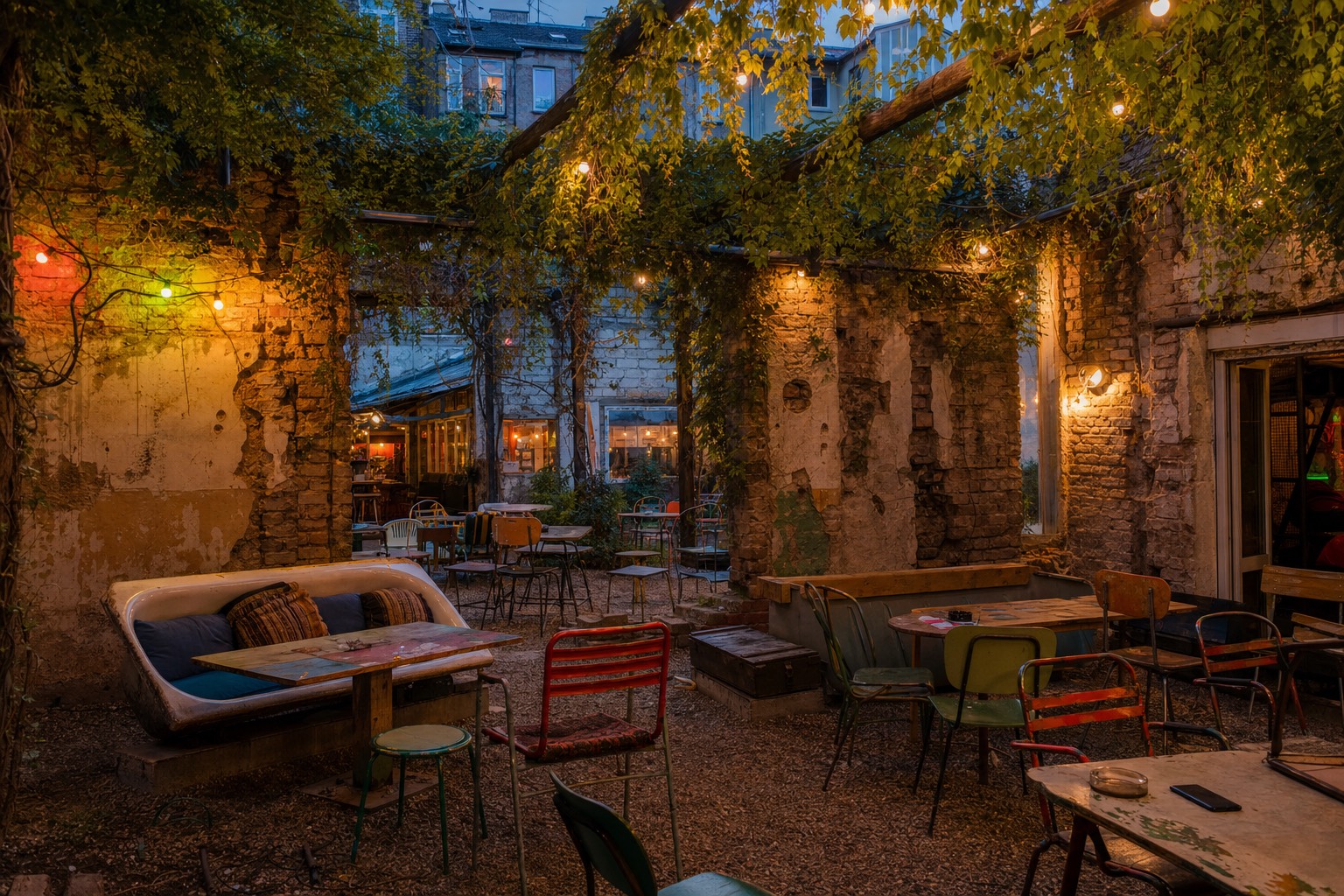
The first time I took an out-of-town friend into Szimpla Kert, she stopped in the doorway and asked if the building was safe. Fair question. The plaster is peeling on purpose, a Trabant car sits where a courtyard garden should be, and the furniture looks rescued from a flood. That collision of decay and life is the whole point, and it grew out of a very specific Budapest story: empty buildings, cheap rent, and a generation that decided a ruin was an asset, not a problem.
Use the venue guide below to choose your own night out. The guided bar walk brings several distinct venues together in one evening.
Booking choice: Visit Lampas, Instant-Fogas and Szimpla Kert while learning about ruin-bar culture, with drinks and a lángos stop. Explore Ruin-Bar Walk With Drinks And Lángos
Why Are They Called Ruin Bars In Budapest?
Because they really are built inside ruins. After decades of neglect, District VII was full of condemned pre-war buildings, and from 2002 onward bar founders rented the shells cheaply, left the crumbling walls exposed, and filled them with flea-market furniture. Hungarians call them romkocsma, literally "ruin pub". The English name is a direct translation.
The word does the marketing on its own, but the history behind it is heavier than a gimmick. District VII is Budapest's old Jewish Quarter. It was walled into a ghetto in 1944, and the neighborhood that survived the war then sat under decades of state neglect. By the 1990s whole blocks stood empty, windows bricked up, courtyards full of rubble, buildings on demolition lists.
Enter a few people with almost no money and a good idea: rent a condemned building for next to nothing, put in a bar license, string up some lights, and let the decay be the decor. No renovation budget became an aesthetic. Mismatched chairs, salvaged doors as tabletops, a projector on a bare firewall. The formula spread through the quarter within a few years, and the "ruin" label stuck because nobody inside these places was pretending otherwise. The walls tell you exactly what the name means.
What Exactly Is A Ruin Bar?
A ruin bar is a bar, and often much more, operating inside an unrenovated old building or courtyard, decorated with salvaged and absurd objects rather than designed interiors. Most fill a former apartment block: a maze of small rooms off a central courtyard, each with its own bar, music, and personality.
The architecture explains the experience. Budapest's 19th century apartment houses wrap around internal courtyards with open walkway galleries on each floor. Turn one into a bar and you get something no purpose-built venue can copy: an open-air heart for summer nights, a warren of rooms for winter, and sightlines from the galleries down onto the crowd. One room plays vinyl, the next screens silent films, a third sells lángos (deep-fried dough with sour cream and cheese) from a hatch.
They are also not only bars. The bigger ones host markets, concerts, community events, and daytime café life. That civic streak is inherited from the founders, who saw themselves as saving buildings, not just selling beer. Plenty of visitors do a ruin bar at 11 pm and a completely different crowd does the same courtyard at 11 am with coffee. My full evening route through the quarter is in the ruin bar evening story.
Which Ruin Bar Started It All?
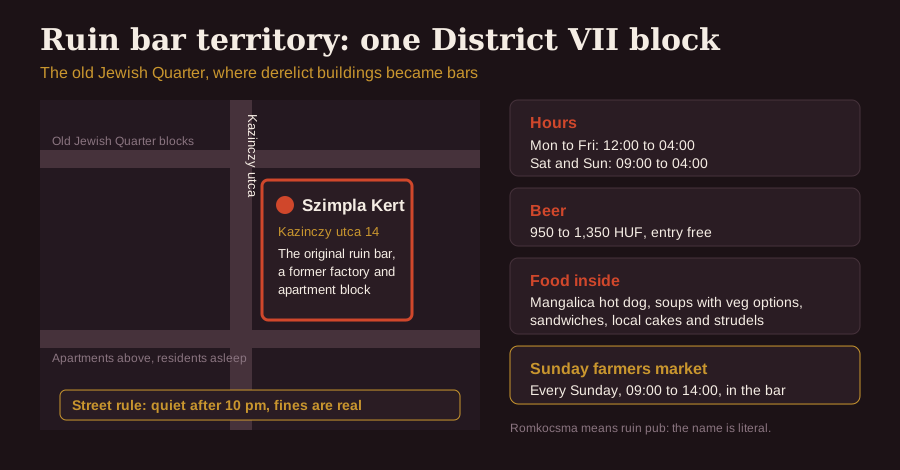
Szimpla Kert, the original and still the most famous. It opened its first small bar in 2002 and settled into its current home, a former stove factory and apartment block at Kazinczy utca 14, in 2004. Every ruin bar since is, one way or another, answering Szimpla.
Szimpla means "simple", kert means "garden", and the name undersells the place magnificently. The Kazinczy utca building is a two-level labyrinth: courtyard cinema screen, the famous gutted Trabant you can sit in, bars themed by room, and decor that changes as regulars donate ever stranger objects. It has been voted among the world's best bars by travel press, which tells you both how good it is and why it gets crowded.
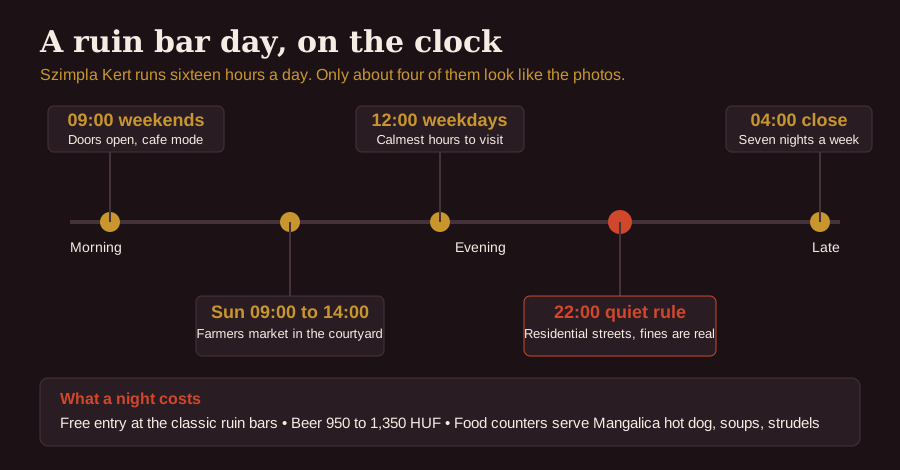
Current hours are generous: Monday to Friday from noon until 4 am, weekends from 9 am until 4 am, per the venue's latest posted schedule. That weekend 9 am start is not a typo, and it matters more than you would guess, because Sunday morning Szimpla is a farmers market, which we will get to.
| Day | Opens | Closes | Worth knowing |
|---|---|---|---|
| Monday to Friday | 12:00 | 04:00 | Afternoons are calm, great for photos |
| Saturday | 09:00 | 04:00 | Morning café mode before the night shift |
| Sunday | 09:00 | 04:00 | Farmers market runs 9:00 to 14:00 |
Can You Actually Eat In A Ruin Bar?
Yes, and better than you would expect. Szimpla Kert serves a Mangalica hot dog, sandwiches, meat and vegetarian soups, and cakes and strudels sourced from local producers. Other big ruin bars host food counters or street-food courtyards, so the quarter works as a casual dinner destination, not just a bar crawl.
Mangalica needs a gloss: it is Hungary's curly-haired heritage pig breed, prized for rich, marbled meat, and putting it in a hot dog is a very District VII move, street food with a pedigree. The soups rotate and always include a vegetarian option, and the strudel and cake counter, stocked from small local producers per recent visitor reports, is the sleeper hit for a mid-afternoon stop.
Set your expectations correctly, though. Ruin bar food is honest and casual, not a substitute for a proper Hungarian table. Think of it as the quarter's snack layer, sitting alongside the street-food courtyards I cover in the street food guide. For the full spread of what this city does with paprika and pork, the what to eat in Budapest guide is the map.
| At Szimpla Kert | What it is | Vegetarian option |
|---|---|---|
| Mangalica hot dog | Heritage-pork sausage in a bun, the house signature | No |
| Soups | Rotating meat and vegetarian pots | Yes |
| Sandwiches | Casual counter fare for the courtyard | Some |
| Cakes and strudels | From local small producers | Yes |
What Is Szimpla's Sunday Farmers Market Like?
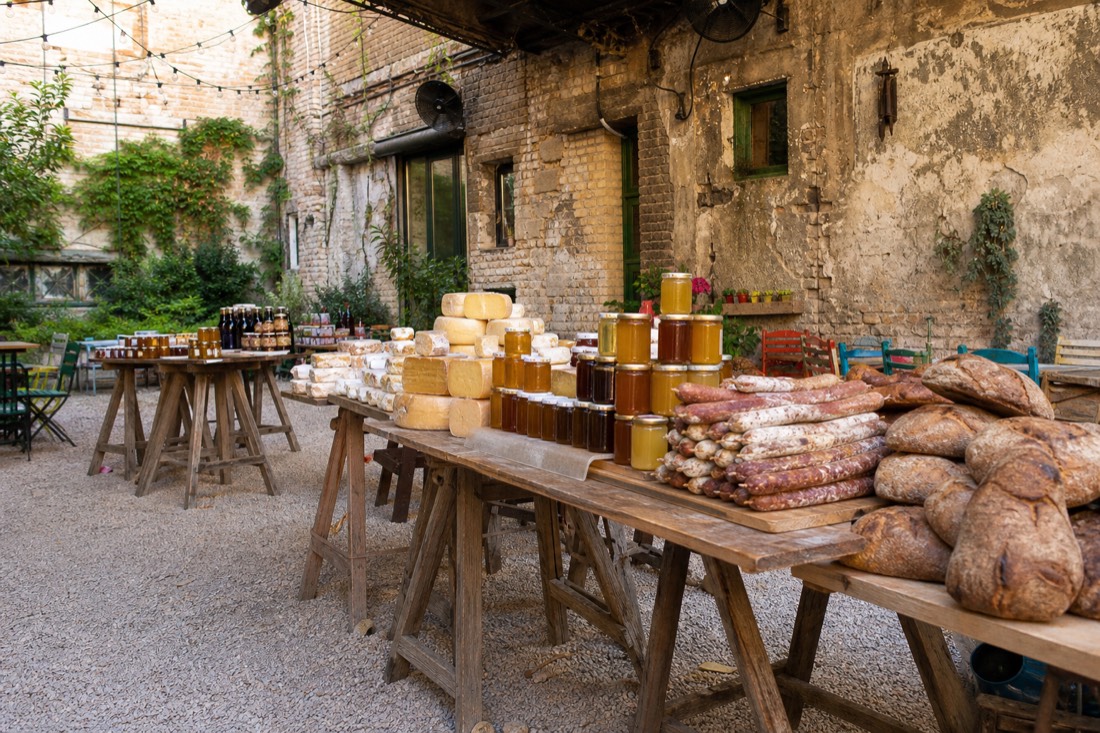
Every Sunday from 9 am to 2 pm the ruin bar becomes a genuine farmers market: local producers selling cheese, honey, sausage, bread, and preserves across the courtyard where the bar crowd stood hours earlier. It is the most local thing that happens in the most touristed building in District VII.
I shop it. That is not a line; the Sunday market is one of the few places in the quarter where you hear more Hungarian than English. Producers drive in from the countryside, the Trabant becomes a photo prop for kids instead of drunks, and there is usually a community cauldron of something hot going for a few coins to a good cause.
It is also the smartest ruin bar visit for anyone who dislikes crowds and noise. You get the full surreal architecture, decay, fairy lights, bathtub sofas, in daylight, sober, with a jar of acacia honey in your hand. Come hungry, graze the stalls, then walk two streets over to the Great Market Hall's big sister experience another morning for comparison. Between the two you will understand Hungarian produce better than most guidebooks do.
How Much Does A Night At A Ruin Bar Cost?
Less than the fame suggests. Beer at Szimpla Kert runs 950 to 1,350 HUF, roughly the citywide norm despite the landmark status, and entry is free. A relaxed evening of three drinks and a hot dog lands well under a typical dinner bill elsewhere in central Pest.
That pricing is a deliberate piece of ruin bar identity. These places built their reputations on being open to everyone, students included, and the big ones have mostly resisted tourist-trap pricing even as the queues grew. Free entry is standard; you pay at each room's bar as you go.
Three honest ways to spend a District VII evening, with what each has on the record:
| Approach | Time window | What the record says |
|---|---|---|
| DIY Szimpla night | Any evening until 04:00 | Free entry, beer 950 to 1,350 HUF, food counters inside |
| Sunday market morning | 09:00 to 14:00 | Local producers, the building at its calmest |
| Foodapest Market to Tavern | 3 hours | 12+ tasters and wines; the evening option skips the market |
A night becomes more expensive as you add drinks and cocktails. For comparison with the rest of the trip, the food prices guide covers meal and drink budgets.
What Is The Etiquette In Ruin Bars And District VII?
Remember that people live here. The quarter's courtyards sit under occupied apartments, and District VII expects quiet on residential streets after 10 pm, with police fines a real possibility for street noise. Inside the bars, order at the bar, share tables, and treat the weird decor as museum pieces, not souvenirs.
The noise point is the one visitors genuinely trip over. The party is loud inside the venues; the offense is carrying it down the street at 1 am. The after-10 pm quiet expectation in residential areas is flagged in current visitor guidance, and locals will tell you the tension between nightlife and neighbors is the district's longest-running argument. Being the quiet group on the pavement is the single best piece of guest behavior available to you.
Inside, the code is simple. Nobody seats you, so claim space politely and share the big tables. Cash or card both work at the established places. Do not pocket the props, do not climb the Trabant, and tip modestly if there is a jar. The rest of the citywide rules, including the service charge system, are in my dos and don'ts guide.
Are Ruin Bars Too Touristy Now?
The famous ones, honestly, yes: Szimpla on a Saturday night is a tourist attraction, and it knows it. That does not make it fake. The building, the food sourcing, and the Sunday market stay genuinely local, and quieter ruin courtyards still exist for those who wander past the headline names.
I will not pretend you will find 2004 in there. Stag parties found the quarter years ago, prices at the flashiest newcomers lean touristward, and on peak nights the queue outside Szimpla looks like an airport. If your measure of authentic is "no other visitors", the headline ruin bars fail it by 9 pm every weekend.
But here is the local defense. The ruin bar model was never a secret garden; it was a public rescue of dying buildings, and popularity is the proof it worked. Go at off-hours and the soul is intact: a weekday afternoon with a coffee in the courtyard, the Sunday market, the first quiet hour after opening. Time your visit like you would time the New York Café queue, and the most touristed room in the district will still hand you a genuinely Budapest evening.
What Is The Right Order For A Ruin Bar Night?
Start in the big famous courtyard while it is still half empty, move to the smaller side-street rooms once the crowd turns, and be off the residential pavements quietly after 10 pm. Szimpla runs to 4 am, so the mistake is arriving late, not leaving early.
The quarter changes character three times in an evening, and most visitors only ever see the loudest version of it. Before about 8 pm the headline courtyards still work as bars: you can find a seat, hear the person opposite you, photograph the Trabant without a queue behind you. Somewhere around 9 pm on a weekend the room fills, the sound level jumps a step, and the same courtyard becomes an attraction rather than a bar. That flip is predictable enough to plan around.
So flip your instincts. Treat the famous address as the early stop, not the climax, and save the small side-street rooms for later, when they are lively rather than empty. The alternative order, arriving at the big courtyard at 11 pm, is how people end up queueing outside a building they could have walked into three hours earlier.
The end of the night has its own etiquette, which we come back to below. Kitchens and food counters do not stay open as long as the bars, so eat while the eating is easy. And if the whole shape of your evening is still open, the ruin bar evening story walks the route in narrative form.
| Time block | Where to be | Why that works |
|---|---|---|
| 17:00 to 19:00 | The big courtyard, seated | Room to move, staff have time to explain the place, best photographs |
| 19:00 to 21:00 | Still there, eating | Food counters are running and you can actually reach the bar |
| 21:00 to 23:00 | Move to smaller side-street rooms | The headline courtyards fill on weekends and conversation gets hard |
| 23:00 to 01:00 | Wherever the music suits you | The quarter is fully awake, all rooms busy, prices unchanged |
| After 01:00 | One room, one crowd, no crawling | Wandering groups are what residents hear at street level |
| Walking home | Volume down, phones down, straight route | Quiet is expected on residential streets after 10 pm and fines are real |
What Should You Eat Before A Ruin Bar Night, And What Inside?
Eat your real Hungarian dinner first, then treat the ruin bar counters as the snack layer they are. Szimpla serves a Mangalica hot dog, sandwiches, meat and vegetarian soups, and cakes and strudels from local producers. Good food, but a bar menu, not a Hungarian table.
The order of operations here decides how your night goes. A bowl of proper paprika stew before you start is the single best piece of preparation available, and the goulash guide explains why the Hungarian version has more heft than the tourist-menu version. Drink first and eat later and you will be hunting for something hot at midnight in a district that empties its kitchens well before its bars.
Inside, order along the grain of the place. The Mangalica hot dog is the house signature and the reason to bother: heritage-breed pork in a bun is a very District VII idea of street food. The soups rotate and always keep a vegetarian pot going, which quietly makes the courtyards one of the easier vegetarian stops in the nightlife quarter. The strudel and cake counter is the one most visitors walk straight past, and it is the best thing there at four in the afternoon with a coffee.
What the counters cannot do is replace dinner for a hungry group at 1 am. Assume food service winds down before the bar does, check the counter hours when you arrive rather than at midnight, and plan your eating for the first half of the evening. The morning version solves the problem completely: come back for the Sunday farmers market between 9 am and 2 pm and eat the region's cheese, honey, sausage and bread in daylight, sober, with nothing louder than a coffee grinder in earshot.
| Stage of the night | What to eat | Why not later |
|---|---|---|
| Before you leave your hotel | A proper Hungarian dinner, stew or a paprika kitchen | Nothing inside the quarter replaces a real meal at 1 am |
| Late afternoon, coffee in the courtyard | Cake or strudel from the local producers counter | The counter most visitors walk straight past, and the room is empty |
| First hour of the evening | The Mangalica hot dog | The house signature, and you can still reach the counter |
| Mid-evening | Soup, meat or vegetarian | Warm, cheap, and it slows the drinking down usefully |
| After midnight | Assume nothing hot is left | Food service winds down well before the bar does at 04:00 |
| Sunday morning, 09:00 to 14:00 | Market cheese, honey, sausage, bread | The best eating that happens in the building all week |
Which Ruin Bar Suits Your Group?
Match the room to the party rather than chasing the famous name. Big courtyards absorb large groups and noise; smaller side-street rooms suit conversation; the Sunday market suits families and non-drinkers. Free entry everywhere means switching costs you nothing but the walk.
The single most common planning error in District VII is treating the quarter as one venue. It is a cluster, and the rooms differ enormously in what they can hold. A courtyard built inside a former apartment block has galleries, multiple bars and open air, so twelve people arriving at once barely register. A single salvaged room off a side street holds a different kind of night, and the same twelve people take it over completely.
Price is not the variable here. Entry is free at the classic ruin bars and beer sits between 950 and 1,350 HUF at Szimpla, which is close to the citywide norm despite the landmark status, so nobody is being punished for choosing the famous address. The variable is fit. Work out what your group actually came for, then pick the room that delivers it.
| Your group | Where to point it | What you get |
|---|---|---|
| Couple wanting the atmosphere without the crush | The big courtyard on a weekday afternoon | Full surreal architecture, a seat, and staff with time to talk |
| A group of eight or more | The big courtyards, early, no booking needed | Space to spread out without swallowing a small room whole |
| Quiet drinkers who came to talk | Smaller side-street ruin rooms after 21:00 | Lively without the courtyard volume, easier to hold a table |
| Families and daytime visitors | The Sunday farmers market, 09:00 to 14:00 | The building sober and in daylight, plus producers to buy from |
| Non-drinkers | Weekday courtyard from noon, cafe mode | Coffee, food counters, and the decor with nothing to prove |
| Solo travellers | Any bar counter on a weekday evening | Shared tables are standard, which makes company easy to find |
How Do You Avoid Annoying The People Who Live Here?
Remember that the courtyards sit under occupied apartments. District VII expects quiet on residential streets after 10 pm, with police fines a genuine possibility, so the offense is almost never what happens inside a bar. It is the volume of your group on the pavement between them.
This is the district's longest-running argument, and visitors keep landing on the wrong side of it without meaning to. Inside a venue, noise is the product and nobody minds. Outside, twenty metres of pavement separates a bar door from someone's bedroom window, and a group of six laughing at 1 am carries up a stone courtyard beautifully. Residents have been listening to that for twenty years.
The practical fix costs nothing. Do your talking inside, keep the walk between venues brief and quiet, and let the smokers cluster tight to the door rather than spreading across the street. If you are ordering a car home, wait inside until it arrives instead of holding a conversation on the kerb. And be the group that lowers its voice when someone leans out of a window, because the alternative is the district tightening rules for everyone.
Inside the venues the code is simpler than it looks. Nobody seats you, so claim space politely and share the big communal tables, which is how the courtyards are meant to work. Order and pay at whichever bar you are standing at rather than waiting for service. The decor is the point of the building, so photograph it and leave it where it is. The rest of the citywide rules, tipping included, sit in the dos and don'ts guide.
What Does A First-timer In District VII Usually Get Wrong?
Gábor Kovács has guided visitors around Budapest since 2022 and, by his own count, has hosted over a thousand of them. The pattern he sees weekly is not bad behaviour. It is bad timing: people arrive at the famous courtyard at the exact hour it stops being enjoyable.
His list is short and consistent. First mistake: treating the ruin bars as a night out rather than a place to look at, then arriving at 11 pm on a Saturday and concluding the whole thing is overrated. Second: skipping dinner, because a hot dog at midnight is not a Hungarian meal and the quarter has better food an hour earlier. Third: doing five venues in one night, which reduces a genuinely strange piece of architecture to a corridor you walked through.
The fourth is the one he cares about most, and it has nothing to do with drinking. Visitors assume the ruined look is a theme, decor bought in and installed. It is not. These were condemned buildings on demolition lists, in a quarter that was a wartime ghetto and then spent decades under state neglect, and the bars are the reason several of them are still standing. Knowing that changes what you see when you walk in.
His own recommendation for a first visit surprises people: come twice. Once on a weekday afternoon or a Sunday morning to actually look at the building, and once in the evening for the version that made it famous. Two short visits beat one long one, and the daylight trip costs almost nothing. For the wider picture of how the quarter eats, the street food guide covers the counters that keep this district fed.
Do ruin bars charge entry?
The classic ruin bars are free to enter, Szimpla Kert included. You simply pay for what you drink and eat, with beer at Szimpla currently running 950 to 1,350 HUF. Special events and concerts at some venues can carry a ticket, but a normal night costs nothing at the door.
Are ruin bars safe?
Yes, by big-city standards. The buildings are inspected venues despite the deliberately ruined look, staff keep order, and the quarter is busy until late. Usual nightlife sense applies: watch your belongings in crowds and keep street noise down after 10 pm, since fines for disturbance are a real thing in District VII.
Can you visit Szimpla Kert during the day?
Absolutely, and daytime may be the best version. Weekdays it opens at noon and weekends at 9 am, running café-style until the evening crowd builds. Sunday morning hosts the farmers market from 9 am to 2 pm, which is the calmest and most local way to see the building.
Choose Your Budapest Experience
Ruin-Bar Walk With Drinks And Lángos. Visit Lampas, Instant-Fogas and Szimpla Kert while learning about ruin-bar culture, with drinks and a lángos stop. Have a date in mind? Check it before arranging the rest of your Budapest day.
180 minutes. Adults 18+. Meet outside Dohány Street Synagogue; finish at Szimpla Kert. Snacks are included; this is not a full dinner.
Choose a date to see scheduled departures. Final availability and price are confirmed on Viator.
No verified experience fits those requirements. Adjust your choices, or keep the independent plan described above.
Compare Options And Fit Your Plans
General recommendations until you choose. Sightseeing cruises use recorded commentary; the dinner cruise has no guide. All selected activities meet in central Pest; use the operator confirmation for the exact point and option.
- Carpe Diem District VII Food Walk: 150 minutes. Four Hungarian eateries, three drinks and an English-speaking guide through District VII. 150 minutes; meet outside the Orthodox Synagogue on Kazinczy utca. Vegetarian and alcohol-free options; no vegan or gluten-free diets.
- Withlocals Private Food Tastings: 180 minutes. Explore Budapest with your own foodie host, with six or ten tastings and vegetarian alternatives on request. Allow 180 minutes for ten tastings; the six-tasting option is 120 minutes. Meet outside the Great Market Hall. No hotel pickup. Tell the host your dietary needs; vegan and coeliac suitability are not established.