Budapest Food Prices in 2026: What Meals, Coffee and Beer Really Cost
Budapest is still the affordable capital of Central Europe, but the menu math has rules. Here is what eating actually costs right now.
 Written with Gábor Kovács, Budapest local specialist and experience guide
Short answer
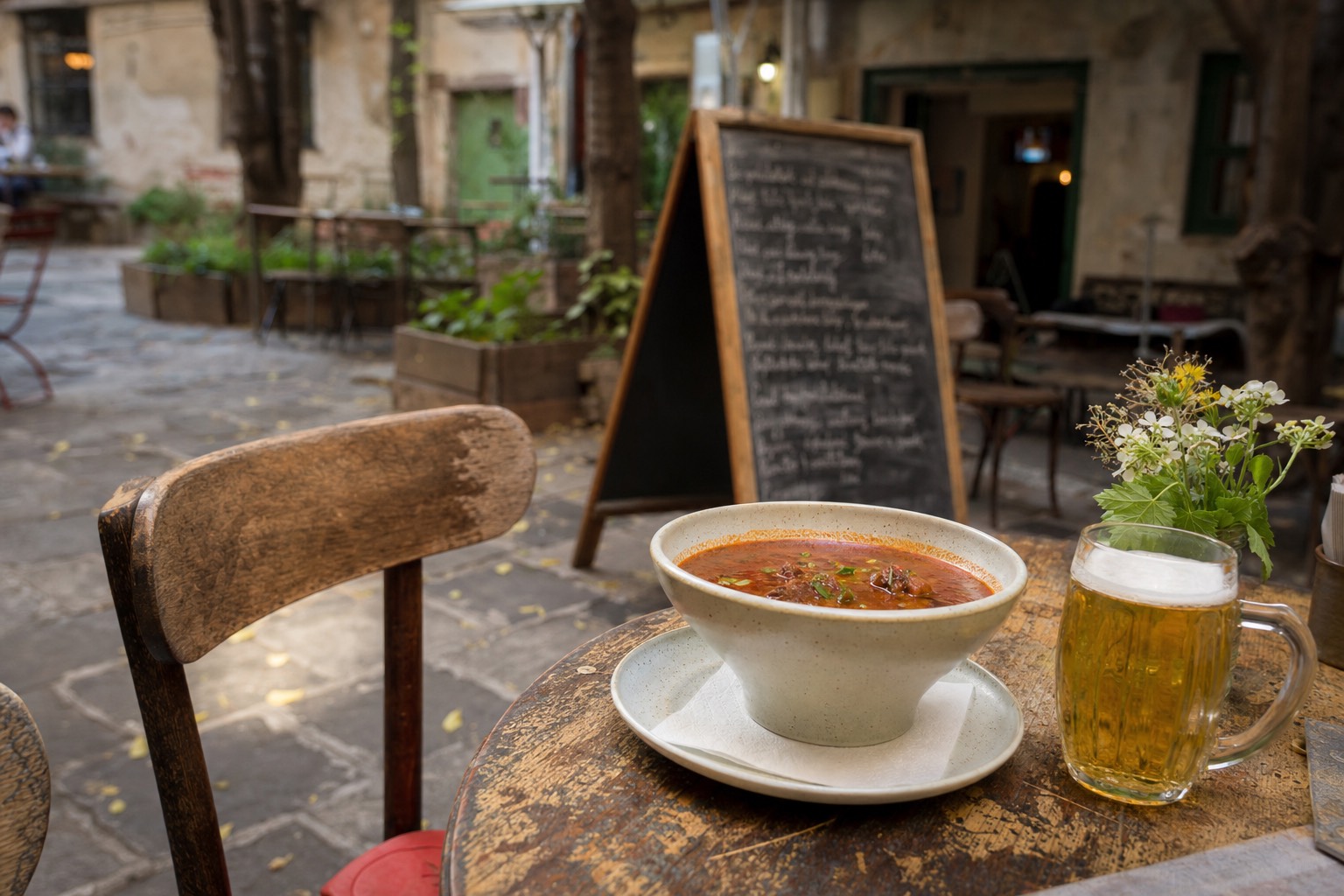
A main course in a mid-range Budapest restaurant runs 3,500 to 8,000 forints, roughly 9 to 20 euros. A daily lunch menu costs about 6 euros, a cappuccino about 1,100 forints, a half-litre draft beer about 1,200. Most sit-down places add a 12.5 to 15 percent service charge, so read the bill before tipping.
The first thing visitors ask me is not where to eat. It is whether Budapest is still cheap. My answer has not changed much since I started guiding in 2022: cheap, no. Fair, very. You can eat a proper cooked lunch for the price of a Vienna coffee, and you can also spend a Vienna dinner budget here without trying. The spread is the story, so let me lay out the actual numbers.
The price tables help with independent meals. For a fair tour comparison, count the included food, drinks and guide time, then enter your own party totals in the calculator at the end.
Booking choice: Foodapest combines traditional dishes, street-food tasters and wines in a three-hour guided walk. Explore Foodapest Market To Tavern
How Much Does Food Cost In Budapest Right Now?
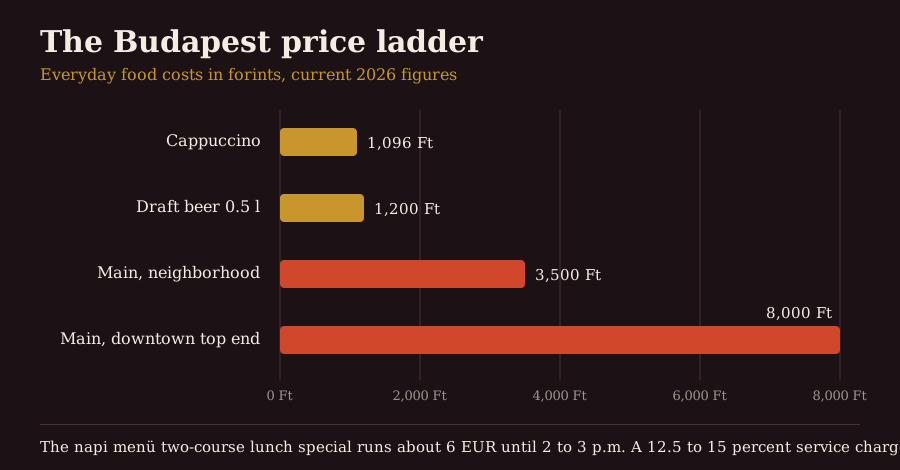
A mid-range restaurant main runs 3,500 to 8,000 forints, about 9 to 20 euros. A daily lunch menu is around 6 euros, a cappuccino about 1,100 forints, and a half-litre of draft beer about 1,200 forints. Street food sits between the coffee and the main, and the service charge adds 12.5 to 15 percent on top.
That is the whole price ladder in one paragraph, and here it is as a table. Every figure is current.
| Item | Price in HUF | Rough EUR |
|---|---|---|
| Cappuccino, regular size | 1,096 Ft | about 3 EUR |
| Draft beer, 0.5 l domestic | 1,200 Ft | about 3 EUR |
| Napi menü (daily two-course lunch special) | varies | about 6 EUR |
| Restaurant main course, mid-range | 3,500 to 8,000 Ft | 8.75 to 20 EUR |
What Does A Main Course Cost In A Budapest Restaurant?
Expect 3,500 to 8,000 forints for a main in a mid-range sit-down restaurant, which converts to roughly 8.75 to 20 euros. The bottom of that band buys a generous plate of chicken paprikás in a neighborhood place; the top buys duck or river fish in a polished downtown room.
The band is wide because Budapest runs two restaurant economies side by side. Neighborhood kitchens in the outer districts still price for locals. Downtown, especially within sight of the Basilica, prices for visitors. Same goulash, sometimes double the number. The figures above come from a current cost breakdown at budapest-trip.com, and they match the menus I walk past every week.
My rule of thumb for guests: if a main downtown costs more than 8,000 forints, you are paying for the address. Two streets back the same dish drops a third. That is not a scandal, every capital works this way, but it is why a three-day eating plan built around markets and neighborhood tables eats better than a plaza-hopping one at twice the spend.
How Cheap Is Lunch If You Eat Like A Local?
The napi menü, the daily two-course lunch special, costs around 6 euros and runs until 2 or 3 p.m. It is soup plus a main, chosen by the kitchen, priced for office workers. It is the single best food deal in the city, and most tourists never notice it exists.
The napi menü (pronounced roughly NOH-pee MEN-oo, literally "daily menu") is a chalkboard, not a laminated card. It changes every day, and as triptobudapest.hu's current budget guide notes, it is gone by mid-afternoon. Soup first, always. Then a stew, a schnitzel, or whatever the market delivered that morning.
I ate these lunches through university and I still hunt them on workdays. The trick is location: look on side streets near offices, not on the tourist axes. If the board is only in Hungarian, that is the confirmation you want, not a problem. Point at the board, hold up fingers for how many, and lunch happens. For eating standing up instead, the street food guide covers the lángos (deep-fried dough with toppings) end of the budget.
What Do Coffee And Beer Cost In Budapest?
A regular cappuccino averages 1,096 forints right now, and a half-litre of domestic draft beer averages 1,200 forints. In plain terms: coffee and beer cost nearly the same, about three euros each, which explains a lot about Budapest afternoons.
Both figures come from Numbeo's live Budapest data, updated this month, and both hide a spread. A third-wave espresso bar in District V charges more than the average; a corner presszó (an old-school stand-up café bar) charges less. The grand cafés are their own category: at the ornate historic rooms like the one in my New York Café guide, you are buying the ceiling along with the coffee, and the bill knows it.
Beer pricing is flatter. The 1,200 forint average holds from ruin bar to restaurant more consistently than any other line on the menu, which makes it the honest unit of account here. When locals say a place is expensive, we usually mean the beer broke 1,500.
What Is The Szervizdíj, And Why Is The Bill Bigger Than The Menu?
Most sit-down restaurants automatically add a service charge, the szervizdíj, of 12.5 to 15 percent to your bill. It is standard practice, the menu states it, and it replaces the tip. Check the bottom line before adding anything on top, or you will tip twice.
The szervizdíj (SER-veez-dee, service fee) is the most common bill surprise in the city. A 5,000 forint main and a 1,200 forint beer do not total 6,200 forints; with the charge they land between roughly 6,975 and 7,130. Nothing was hidden, the percentage was on the menu, but almost nobody reads that line on holiday.
| The bill, worked through | Amount |
|---|---|
| Main course (mid-band example) | 5,000 Ft |
| Draft beer, 0.5 l | 1,200 Ft |
| Subtotal | 6,200 Ft |
| Service charge at 12.5 to 15 percent | 775 to 930 Ft |
| What you actually pay | 6,975 to 7,130 Ft |
When the charge is on the bill, you are done; no tip owed. When it is absent, ten percent in cash is the local norm. The full etiquette, including card-machine tipping screens, lives in my tipping and service charge guide.
Are Budapest Food Prices Rising In 2026?
No, they are easing. Food prices in Hungary fell 2.4 percent year over year in June 2026, after several rough inflation years. Menus have not dropped visibly, but they have stopped climbing, and lunch specials have quietly gotten more generous again.
This surprises people who read about Hungary's inflation spike a few years back, and the relief is real: Trading Economics, tracking the Hungarian statistics office, shows food prices down 2.40 percent in June 2026 against the previous year. On the street, the effect is stability. The napi menü boards I watch have held their prices through the year, and portions crept back up first, the way they always do here.
For a visitor, the practical meaning is that this guide's numbers should hold through your trip rather than expiring in a month. Forint prices move faster in tourist zones than the statistics suggest, so treat downtown menus, not the data, as your worst case.
What Should You Budget Per Day For Food In Budapest?
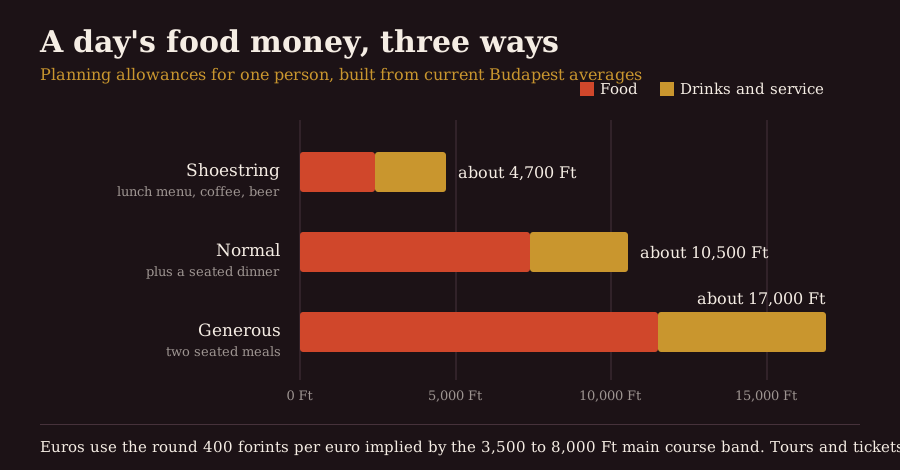
Three honest daily allowances for one person, built only from the averages already on this page: about 4,700 forints on a shoestring, about 10,500 forints on a normal eating day, about 17,000 forints if you eat generously. These are planning figures, not quotes, and none of them includes a tour, a ticket or a taxi.
Every euro figure below uses the round 400 forints per euro that this guide's own band implies, since 3,500 to 8,000 forints was quoted as 8.75 to 20 euros. That keeps the arithmetic transparent rather than magical. Where a real rate differs on the day, the forint column is the one to trust.
The shoestring day is a napi menü lunch at around 6 euros, one cappuccino and one beer. That is the whole line, and it deliberately leaves out whatever you buy in the market for breakfast, because a bag of bread, cheese and paprika salami has no average price worth printing. The normal day adds a sit-down dinner: one mid-band main and a beer, plus the service charge that lands on any seated bill. The generous day is two seated meals, the second at the top of the mid-range band, with drinks and coffee on top. Notice that it is still not a fine dining day. Michelin-level rooms sit above this ladder entirely.
| Day type | What it buys | Built from | Allow roughly |
|---|---|---|---|
| Shoestring | Napi menü lunch, one coffee, one beer, breakfast bought in a market | 6 EUR lunch, 1,096 Ft cappuccino, 1,200 Ft beer | About 4,700 Ft, roughly 12 EUR |
| Normal | Napi menü lunch, then a seated dinner of one main and a beer, plus a coffee | 6 EUR lunch, 5,000 Ft main, 1,200 Ft beer, 1,096 Ft coffee, service charge | About 10,500 Ft, roughly 26 EUR |
| Generous | Two seated meals, the second at the top of the mid-range band, two drinks and a coffee | 3,500 Ft and 8,000 Ft mains, 2,400 Ft in beer, 1,096 Ft coffee, service charge | About 17,000 Ft, roughly 42 EUR |
Where Does The Money Actually Go On A Food Trip?
Not on the food, mostly. On a trip built around eating, the plate is the steady line: drinks, the 12.5 to 15 percent service charge and the address you sit at move the daily total far more than the dish you pick. Two of those three are decided before you open the menu.
Run the numbers on drinks and the point makes itself. A cappuccino averages 1,096 forints and a half-litre of draft beer 1,200, so three drinks across a day lands near 3,500 forints, which is the price of an entire neighbourhood main course. Visitors who feel their budget slipping have usually not eaten more. They have had a coffee at eleven, a beer with lunch, a spritz before dinner and a wine after it.
The service charge is the second silent line. On the worked bill higher up this page, 775 to 930 forints appeared on a 6,200 forint subtotal without anybody ordering it. That is not a scam, the menu says so, but across four seated meals it is a meal of its own.
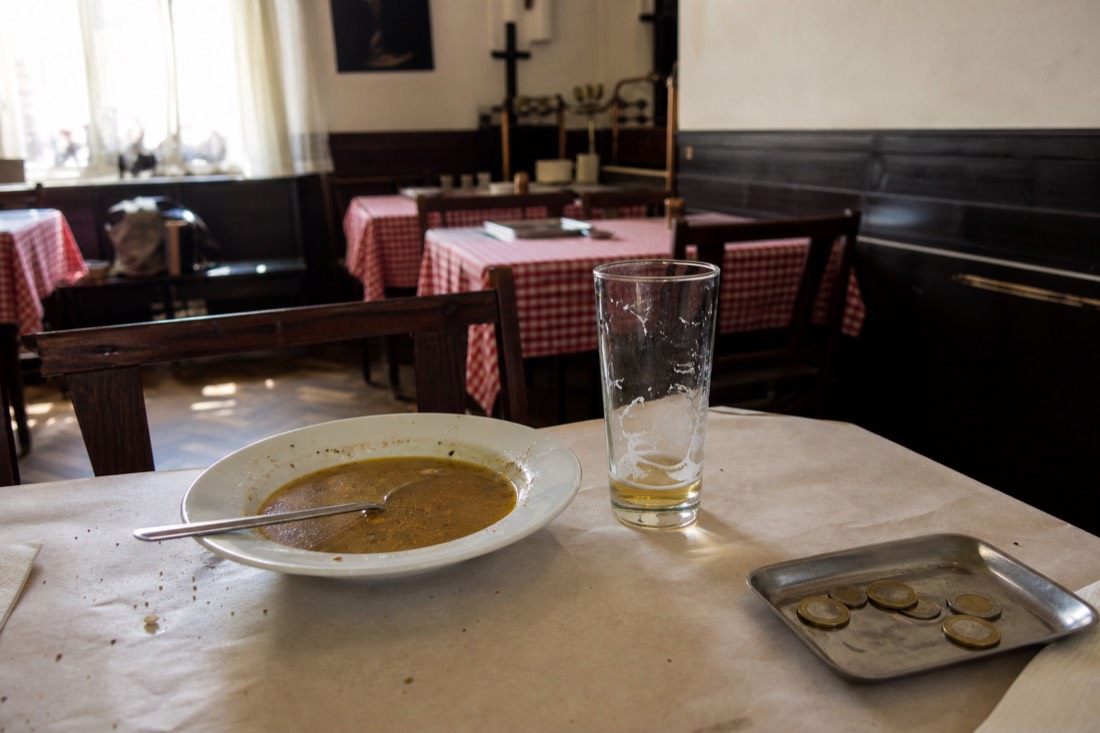
Third is the address, and it is the only one with a genuinely free fix. Walking is free. The dish is the same. So the practical levers, in order of size, are how many seated meals you eat per day, how many drinks you order at them, and which street you order on. Change any one and the daily figure moves more than switching from duck to chicken paprikás ever will.
How Do Prices Differ Between The Market, A Neighbourhood Kitchen And The Tourist Strip?
The same dish carries three prices depending on who the room is priced for. A market counter prices for turnover, a neighbourhood kitchen prices for regulars who come back on Thursday, and a downtown strip prices for the address. A main pushing past 8,000 forints downtown is telling you about rent, not cooking.
The mechanism is dull and universal: footfall and rent. A room that can fill itself twice a night from passing traffic never needs a regular, so it never needs to be cheap. A kitchen four streets back has to be worth a walk, which is why the napi menü board exists at all and why it disappears by early afternoon.
That gives you tells rather than rules. Look for a board that changes daily instead of a laminated card. Look at who is queuing and what time it is. Look for prices given per 100 grams on fish and meat, which is legal, common and the single easiest way to misread a menu, because the number you see is not the number the plate costs.
| Setting | What the price pays for | The tell before you order | The trap |
|---|---|---|---|
| Market hall counter | Turnover and a lunch queue | A line of people who are not photographing the building | Following the biggest picture menu rather than the queue |
| Neighbourhood kitchen | Regulars who return weekly | A handwritten daily board, often Hungarian only | The board is finished by 2 to 3 p.m. |
| Downtown tourist strip | The address and the passing traffic | Mains pushing past 8,000 Ft | Unpriced daily specials and per-100g fish or meat |
| Grand café | The room, the ceiling, the century | Waiters in waistcoats and a queue at the door | Treating it as lunch rather than as the occasion it is |
The Great Market Hall guide covers the first row in detail, including which floor to buy which thing on.
What Are The Three Most Expensive Mistakes Visitors Make?
Changing money at a tourist exchange window, eating within sight of the landmark, and accepting whatever arrives on the table unordered. None of them appears on any menu as a price, all three land on the bill, and each takes about ten seconds to avoid.
Start with money, because it is the one that costs before you have eaten anything. Exchange desks in the tourist streets make their margin on the spread, not on a printed fee, so the rate on the window is the product. Paying by card in forints skips the whole conversation. When a terminal offers to charge you in your home currency, that is dynamic currency conversion, and it is a second conversion at somebody else's rate stacked on your bank's. Decline it. The screen makes declining look like the risky option, which is the point of the design.
The second mistake is geographic and forgiving. Nobody is being cheated on the strips; the price is honest, it just includes the view. Two streets back the same kitchen output costs meaningfully less, and the walk takes less time than waiting for a table on the strip does.
The third is the quietest. Bread, spreads, bottled water and garnishes that nobody ordered are sometimes chargeable items, and the polite moment to ask is when they land, not when the bill does. Then read the bottom of that bill: the szervizdíj is already there, and adding a tip on top of it is a voluntary 12.5 to 15 percent donation.
| Mistake | Why it costs | The tell | Do this instead |
|---|---|---|---|
| Tourist-strip exchange window | The margin sits in the spread, invisible as a fee | A rate board on a busy pedestrian street | Pay by card in forints; withdraw from a bank's own machine |
| Accepting the home-currency prompt | A second conversion on top of your own bank's | The terminal offers EUR, GBP or USD as the friendly option | Always choose HUF, even when the screen discourages it |
| Unordered items on the table | Bread, water and extras can be chargeable | Something arrives that nobody asked for | Ask on arrival, then check the bill against the menu |
How Much Do The Food Tours Cost?
We do not print tour prices on this site, on purpose. Operators adjust them by season and date, and a stale number would mislead you the way an old menu would. Every listing shows the live price, and comparing what each walk includes tells you more than any fixed figure could.
What I can compare honestly is what you get. The comparison table does this for every experience we cover; here is the food-walk slice of it.
| Experience | What is included | Reviews | Price |
|---|---|---|---|
| Carpe Diem tasting walk, 150 minutes | Four eateries and three drinks | Current operator listing verified September 2026 | Check your actual date and party |
| Foodapest market-to-tavern, 3h | 12+ tasters incl. goulash, lángos, chimney cake, wines | 4.9 across 581 GetYourGuide reviews | Live on the listing |
Does A Guided Tasting Replace Meals, In Budget Terms?
A substantial tasting can replace a meal for some travellers, but that depends on appetite and the inclusions. Carpe Diem lasts 150 minutes, Foodapest three hours. Compare a quote for your date with the meals you would actually skip.
Here is the honest way to run the comparison yourself. A seated dinner of one mid-band main and a beer came to 6,200 forints before service and between 6,975 and 7,130 after it. A walk that feeds you at four places and pours three drinks displaces that dinner and most of a lunch. So when you open the listing, hold the live price against roughly one seated dinner plus a light lunch, not against a single lángos from a market counter.
Then apply the counterweight, because value cuts both ways. If your alternative plan is napi menü lunches at around 6 euros and neighbourhood dinners at the bottom of the 3,500 to 8,000 forint band, no guided walk will beat that on forints alone. It is not competing on price. What it sells is access and explanation: places you would walk past, dishes you would not order, and someone answering why the paprika tastes like that. Some visitors want that on day one and cook the rest of the week. Others would rather spend the same money on two dinners.
Is Budapest cheaper than Prague or Vienna for food?
Vienna, clearly yes: restaurant prices there run well above Budapest's, and the gap shows on every line from coffee to mains. Prague is closer to parity. Within Budapest itself, the district you eat in moves your costs more than the country comparison does.
Should I pay in forints or euros?
Forints, always. Some tourist-zone places accept euros at their own rounded rate, and that rate never favors you. Pay by card in HUF, and if a terminal offers to charge you in your home currency, decline it.
Do I still tip if there is a service charge?
No. The szervizdíj replaces the tip, and the menu states the percentage. Tip around ten percent in cash only when no charge appears on the bill, or when someone genuinely rescued your evening.
Choose Your Budapest Experience
Foodapest Market To Tavern. Traditional dishes, street-food tasters and wines with an English-speaking local guide. Have a date in mind? Check it before arranging the rest of your Budapest day.
180 minutes. Daytime option visits the market; the 17:00 option skips it. Notify the operator about vegetarian or vegan substitutions. Not suitable for coeliac requirements.
Choose a date to see scheduled departures. Final availability and price are confirmed on Viator.
No verified experience fits those requirements. Adjust your choices, or keep the independent plan described above.
Compare Options And Fit Your Plans
General recommendations until you choose. Sightseeing cruises use recorded commentary; the dinner cruise has no guide. All selected activities meet in central Pest; use the operator confirmation for the exact point and option.
- Carpe Diem District VII Food Walk: 150 minutes. Four Hungarian eateries, three drinks and an English-speaking guide through District VII. 150 minutes; meet outside the Orthodox Synagogue on Kazinczy utca. Vegetarian and alcohol-free options; no vegan or gluten-free diets.
- Private Coffee And Cake Walk: 150 minutes. Discover Budapest’s grand cafés, neighbourhood confectioneries and strudel shops with a private local guide. Confirm the pickup point with the operator. Coffee and dessert stops form the experience; dietary suitability and specific cafés need confirmation.
- Budapest Culinary And Wine Walk: 300 minutes. Explore food markets and neighbourhoods with an English-speaking food specialist, tasting Hungarian dishes and wines along the way. Allow five hours and substantial walking. Current option is private; private transport and gratuities are excluded. Dietary arrangements require confirmation.
- Withlocals Private Food Tastings: 180 minutes. Explore Budapest with your own foodie host, with six or ten tastings and vegetarian alternatives on request. Allow 180 minutes for ten tastings; the six-tasting option is 120 minutes. Meet outside the Great Market Hall. No hotel pickup. Tell the host your dietary needs; vegan and coeliac suitability are not established.