Tipping in Budapest 2026: Szervizdíj Rules, the 15% Cap, What to Leave
The whole system in one rule, check the bill for a szervizdíj line before you reach for your wallet.
 Written with Gábor Kovács, Budapest local specialist and experience guide
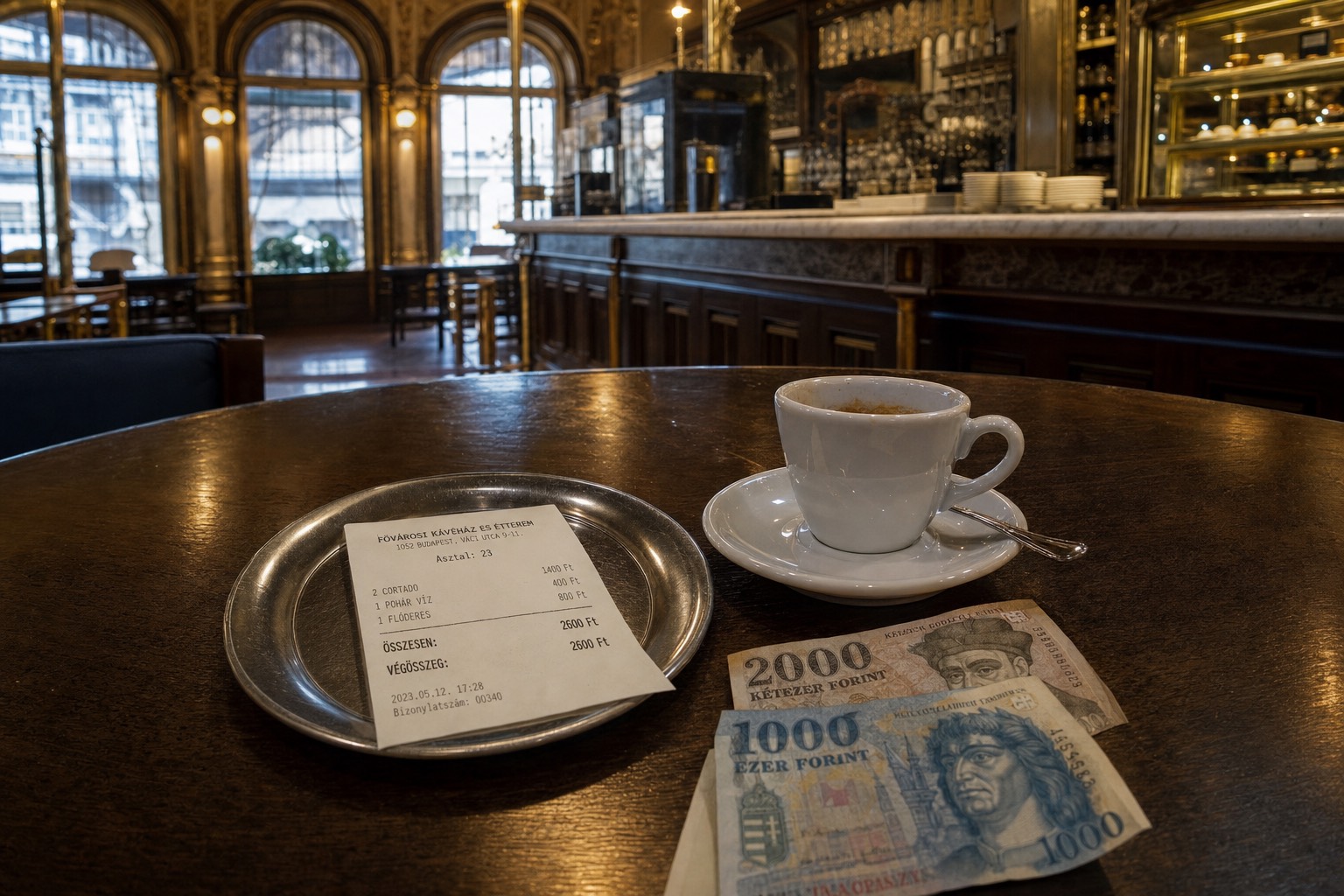
Short answer
Look at the bill first. If a szervizdíj (service charge) line of 10-15% is printed, pay it and you owe nothing more. If there is no such line, leave 10-15% for good service. Hungarian law caps the service charge at 15% for private diners, and card tips are now fine, just say the total before the terminal appears.
My grandfather tipped with coins pressed straight into the waiter's palm, always cash, always with a little nod. Then somewhere around 2023 half the restaurants in my city started printing a service line on the bill, and suddenly even my Hungarian friends were doing math at the table. Visitors have it worse. So here is the whole system, the way I explain it to guests before we sit down anywhere in District VII.
Use the bill-reading advice for independent meals. When comparing a tour, separate included food and drinks from optional gratuities, then use your own quotes in the calculator below.
Booking choice: Foodapest combines traditional dishes, street-food tasters and wines in a three-hour guided walk. Explore Foodapest Market To Tavern
Do You Have To Tip In Budapest?
No law obliges you to tip in Budapest, but the custom is strong. The deciding factor is the bill itself: when a szervizdíj (service charge) of 10-15% is already printed, nothing more is expected. When the bill shows no service line, a 10-15% tip for decent table service is the accepted norm.
That one distinction settles about ninety percent of situations. The confusion comes from the transition we are living through. A decade ago almost no Budapest restaurant added a service charge and everyone tipped in cash. Now a printed charge is increasingly the standard, typically 10-15%, and budapest.com's payments FAQ carries the consumer-authority guidance to confirm before ordering whether one applies. Menus must state it, usually in a footer line, so a ten-second glance saves you from paying for service twice.
Locals, for what it is worth, tip less than visitors think. Five to ten percent is normal among Hungarians, and nothing at all over a bill that already carries the charge. You will not offend anyone by matching that.
| Situation | What you do |
|---|---|
| Bill shows szervizdíj 10-15% | Pay the total, add nothing |
| Bill shows no service line, service was fine | Add 10-15% |
| Bill shows no service line, service was poor | Add little or nothing, this is normal here |
| Counter service, bakery, lángos window | No tip expected, a rounded-up total is a kindness |
| Self-service buffet or canteen | No service charge is even allowed here |
What Is Szervizdíj And What Does The Law Actually Say?
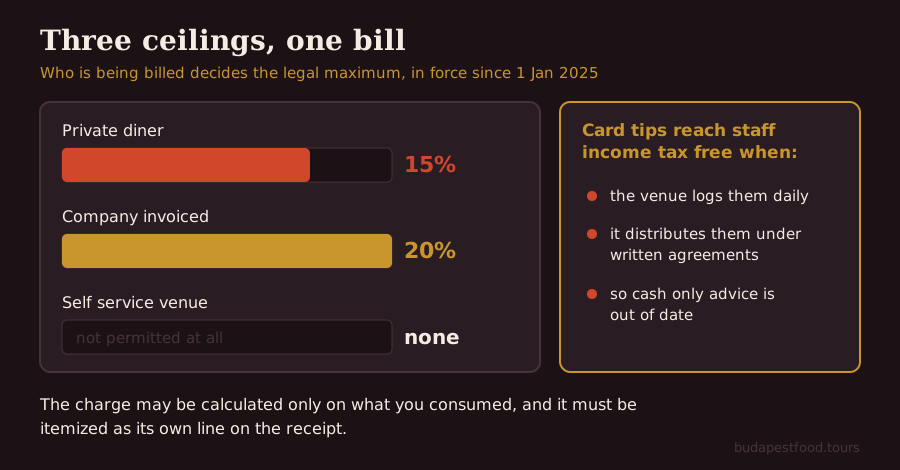
Szervizdíj is a service charge the restaurant adds to your bill and distributes to staff. Since 1 January 2025 Hungarian law caps it at 15% of the gross, VAT-inclusive bill for private diners, requires it to be itemized separately, and bans it entirely in self-service venues.
This is recent regulation, and it exists because a few places were quietly stacking 18% or 20% onto tourist bills. Under the 2025 rules, summarized clearly by officina.hu's guide to tips and service charges, the charge may only be calculated on what you actually consumed, must appear as its own line on the receipt, and tops out at 15% when you are paying as a private person. There is one exception worth knowing if you travel on business: where a company is being invoiced, the ceiling rises to 20%, a detail confirmed in a 2026 tax-practice summary of the amended rules.
So if you ever see 18% appear on a personal dinner bill, that is not a quirky house policy. It is over the legal limit, and politely pointing at the line usually resolves it fast.
The charge is not a scam in itself, I want to be fair about that. It is how many kitchens now pay their teams a steadier wage. You are only being cheated when it is hidden, miscalculated, or used to pressure a second tip on top.
How Do You Read A Hungarian Restaurant Bill?
A Hungarian bill lists your items, then any szervizdíj as a separate itemized line with its percentage, then the total, usually marked összesen. Check three things: that the service line matches the advertised percentage, that it is 15% or less, and that it was calculated only on your food and drink.
The vocabulary is the hurdle, so here is the anatomy, line by line:
| On the bill | Means | What to check |
|---|---|---|
| Étel, ital | Food, drink items | Only things you ordered, watch for unordered bread |
| Szervizdíj or felszolgálási díj | Service charge | Itemized separately, 15% max, matches the menu |
| ÁFA | VAT | Informational, already inside the prices |
| Összesen | Total | Items plus service charge, nothing mysterious |
| Borravaló | Tip | Never pre-printed, this one is always yours to decide |
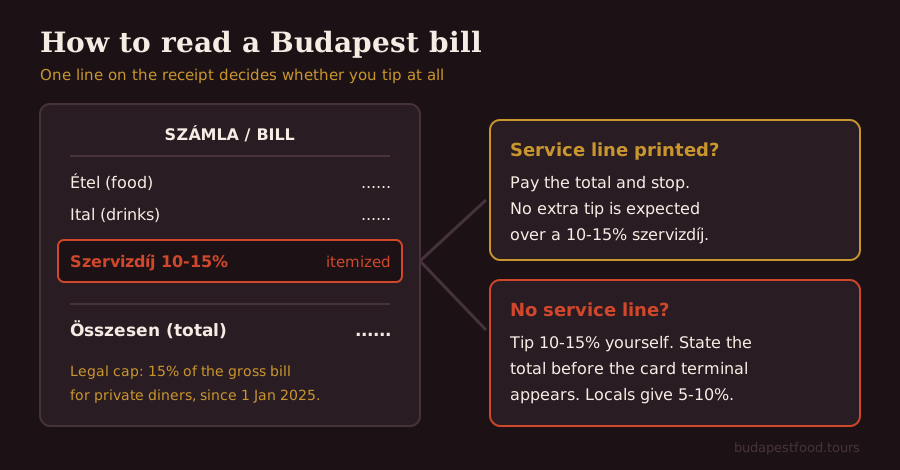
A quick word on that unordered bread. In heavily touristed spots a basket sometimes lands on the table uninvited and later appears on the bill. You may wave it away when it arrives, and you may query it when it appears as a charge. More on that habit in my food dos and don'ts guide.
How Much Should You Tip When There Is No Service Charge?
With no szervizdíj on the bill, 10% is a solid tip and 15% signals genuinely great service. Hungarians themselves often leave 5-10%. Round to a clean figure in forints rather than computing an exact percentage, and hand it over or state it, because leaving coins on the table is not the local way.
The mechanics matter as much as the amount. In Hungary you usually settle the tip at the moment of payment, not by abandoning money on the tablecloth. When the server tells you the total, you answer with the figure you want to pay. Bill says 8,700 forints, you say "make it 9,500" or simply "tízezer" (ten thousand), and the change stays with them.
One phrase to know: köszönöm, thank you. Said at the exact moment you hand over cash, it traditionally means keep the change. My mother still deploys it with surgical timing. If you want change back, hold the thank-you until the change returns.
Percentages feel abstract in a currency with lots of zeros, so anchor yourself with my Budapest food prices guide, and here is a cheat sheet:
| Where you are | No service line on bill | Service line printed |
|---|---|---|
| Sit-down restaurant | 10-15% | Nothing extra |
| Café or cukrászda (pastry shop) with table service | ~10% or round up | Nothing extra |
| Bar or ruin pub, table service | ~10% | Nothing extra |
| Standing at the bar | Round up if you like | n/a |
| Market stall, street food window | Not expected | n/a |
| Food tour or tasting guide | 5-10% of tour value if delighted, cash | Tastings already included |
Should You Tip By Card Or In Cash?
Both now work. Since the 2025 tax changes, card tips can reach staff income-tax free when the restaurant records and distributes them properly, so the old "cash only" advice is outdated. The one rule: say the tip amount before the terminal appears, because Hungarian card machines rarely offer a tip prompt afterwards.
Cash still has its charm and its certainty. A banknote handed to your server unambiguously reaches your server. But I watch guests panic-hunt for an ATM at the end of dinner, and there is no need anymore. The same 2025 reform that capped the service charge also cleaned up the tax treatment of card tips, so a well-run place has every reason to accept them.
The practical wrinkle is timing. Waitstaff bring the terminal with the exact total already typed in. If you want to tip on card, the moment to speak is when they announce the amount, not after the beep. At the Great Market Hall stalls and most street windows, though, keep small cash handy; a tip is not expected there anyway, as I explain in the Great Market Hall guide.
Do You Tip Your Guide On A Food Tour?
On a guided tasting walk every bite and pour is prepaid, so no restaurant tipping happens at the stops. Tipping the guide is optional and appreciated rather than assumed: a few thousand forints in cash, roughly 5-10% of the tour price, is a warm gesture for a guide who made the evening.
Guides here do not solicit tips, and guests report the no-pressure atmosphere as part of the charm. If yours was excellent, cash at the end, hand to hand, is exactly right.
What Tipping Mistakes Should Visitors Avoid?
The classic errors: tipping a second time on top of a printed szervizdíj, leaving coins scattered on the table American-style, saying köszönöm while handing cash and losing your change, and accepting a service charge above 15% on a private bill without question. All four are easy to dodge once you know they exist.
Double-tipping is the expensive one. I have watched a table pay a 12.5% printed charge and then add 15% on top out of habit, a 27% premium on dinner that no local would ever pay. The restaurant will not stop you. The bill will.
The over-cap charge is rarer but nastier. It clusters in the same tourist corridors where the menus have photographs and a host waves you in from the pavement, places I map out in the dos and don'ts guide. Since the cap is written into law, you are on firm ground querying anything above 15%.
And relax about small stuff. Nobody here tracks whether you tipped the barista. Any question about how the tours themselves handle payment usually has a one-line answer: everything edible is prepaid.
Who Do You Tip In Budapest Beyond The Restaurant Table?
Outside sit-down dining the expectation drops away fast. Bars, taxis and hotel staff take a rounded-up figure or a small note, market stalls and counters take nothing, and only table service carries the 10-15% norm, and only where the bill shows no szervizdíj line.
A food trip puts you in front of eight or nine different people who might expect something, and the low-level anxiety about it costs visitors more energy than the money ever does. Sorted by who is actually receiving, the map is small.
| Who you are paying | The customary move | Cash or card | Moment it changes hands |
|---|---|---|---|
| Restaurant table service, no service line | Name a total 10-15% above the bill | Either works now | When the server states the amount |
| Restaurant with szervizdíj printed | Pay the total, add nothing | Either | Does not arise |
| Bartender you order from standing | Round the round up if you feel like it | Cash is simplest | With each order |
| Ruin bar with a server at your table | Round up, café level rather than restaurant level | Either | At settle-up |
| Market stall or lángos window | Nothing expected | Cash | Does not arise |
| Bakery or coffee counter | Nothing expected, coins in the jar are a kindness | Cash | On collection |
| Taxi or booked car | Round the fare to a clean figure | Cash or in-app | On arrival |
| Hotel housekeeping | A small note left in the room if you want to | Cash | Any day, not only checkout |
| Hotel porter with your bags | A small note | Cash | At the door |
| Cloakroom, ruhatár | Usually a posted fee, so nothing on top | Cash | On collection |
| Tasting-walk or cooking-class guide | 5-10% of the tour value if delighted | Cash | At the end, hand to hand |
Two rows surprise people. The counter economy wants almost nothing from you: a stall that has just handed over a paper plate of lángos considers the exchange closed, and nobody behind a bakery till is keeping score. Hotels are the other one. Leaving something for housekeeping is not a strong Hungarian reflex the way it is in North America, so it reads as generous rather than expected, and it lands better spread across the stay than heaped on the final morning. If you are still choosing a base, my guide to where to stay in Budapest covers the neighbourhoods where you will be eating anyway.
The guide row is the one I get asked about most, and the honest answer is that it sits outside the bill system entirely. Nothing at the tasting stops is yours to settle, so whatever you hand a guide at the end is purely a verdict on the four hours.
How Does Paying By Card Actually Work At A Budapest Table?
The sequence barely varies. You ask for the bill, it arrives printed, the server keys the exact total into a handheld terminal and carries it over. Any tip has to be spoken before that number goes in, because the machine will not prompt you for one afterwards.
Servers here will not drop the bill on you as a hint to leave. The table is yours until you ask, which means the whole transaction starts with you catching an eye and saying "fizetnék" (fee-ZET-nayk), I would like to pay. What comes back is a printed slip, and reading it in front of them is completely normal behaviour, not an accusation.
Splitting is the step most groups fumble. Say it before anything is keyed, because once the total is entered the server has to void and restart. Most Budapest kitchens will run four cards without a sigh; a few small family places genuinely cannot, and they will tell you.
One detail worth knowing if you are travelling on business: asking for a számla, a company invoice, rather than a plain nyugta receipt changes which legal ceiling applies. Private bills cap the service charge at 15%, while a company being invoiced can be charged up to 20% of gross consumption. Same restaurant, same dinner, different maximum, purely because of who the paperwork names.
| Moment at the table | What is happening | What you do |
|---|---|---|
| You are ready to leave | Nothing, nobody will hurry you | Catch an eye, say "fizetnék" |
| The bill arrives | Items, any szervizdíj line, the total | Read it for ten seconds, this is normal here |
| Cash or card is decided | The server asks, or you volunteer it | "Kártyával" or "készpénzzel" |
| You want it split | Possible almost everywhere, if asked early | Say "külön-külön" before anything is keyed |
| The total is being typed | Tip included only if you said one | Speak your figure now |
| The terminal offers your home currency | A conversion screen can appear | Take the forint option |
| The beep | Receipt prints, the transaction is closed | Any tip from here has to be cash |
What Do You Say In Hungarian At The Moment Of Paying?
Five phrases cover the entire transaction: asking for the bill, choosing card or cash, naming a rounded total, keeping or refusing your change, and thanking the server. English works in central Budapest, but the Hungarian version of the tip line removes every ambiguity about what you meant.
The reason to learn these is not politeness theatre. Tipping here is spoken aloud rather than left on the table, so the sentence you say is the mechanism. Get the phrasing right and there is nothing to misread.
| Hungarian | Say it roughly like | What it means | When to use it |
|---|---|---|---|
| Fizetnék | FEE-zet-nayk | I would like to pay | To start the whole exchange |
| Kártyával fizetek | KAR-tyah-vahl FEE-zeh-tek | I am paying by card | Before the terminal is keyed |
| Van szervizdíj? | von SER-veez-dee | Is there a service charge? | Before ordering, or when the bill lands |
| Legyen tízezer | LED-yen TEEZ-eh-zer | Make it ten thousand | Naming your total, tip included |
| Kérek vissza | KAY-rek VISS-so | I would like change back | When paying cash and not tipping the whole remainder |
Swap any number into that fourth phrase and it keeps working: nyolcezer is eight thousand, tizenötezer is fifteen thousand. If numbers are a step too far, saying the figure in English while the server holds the terminal is understood everywhere in the centre, and pointing at the amount on the bill and then at your rounded figure works even in a loud ruin bar. The ruin bar guide has more on where those loud rooms are.
Remember the trap from earlier in this guide: köszönöm at the moment cash leaves your hand means keep it all. Kérek vissza is its antidote, and the two of them together are the entire cash-tipping system.
What Should You Check On The Bill Before You Hand Over Your Card?
Give it ten seconds and check four things: that every line is something you ordered, that no bread or cover charge appeared uninvited, that any service line matches the percentage the menu advertised and sits at 15% or under, and that the service charge was calculated on your consumption alone.
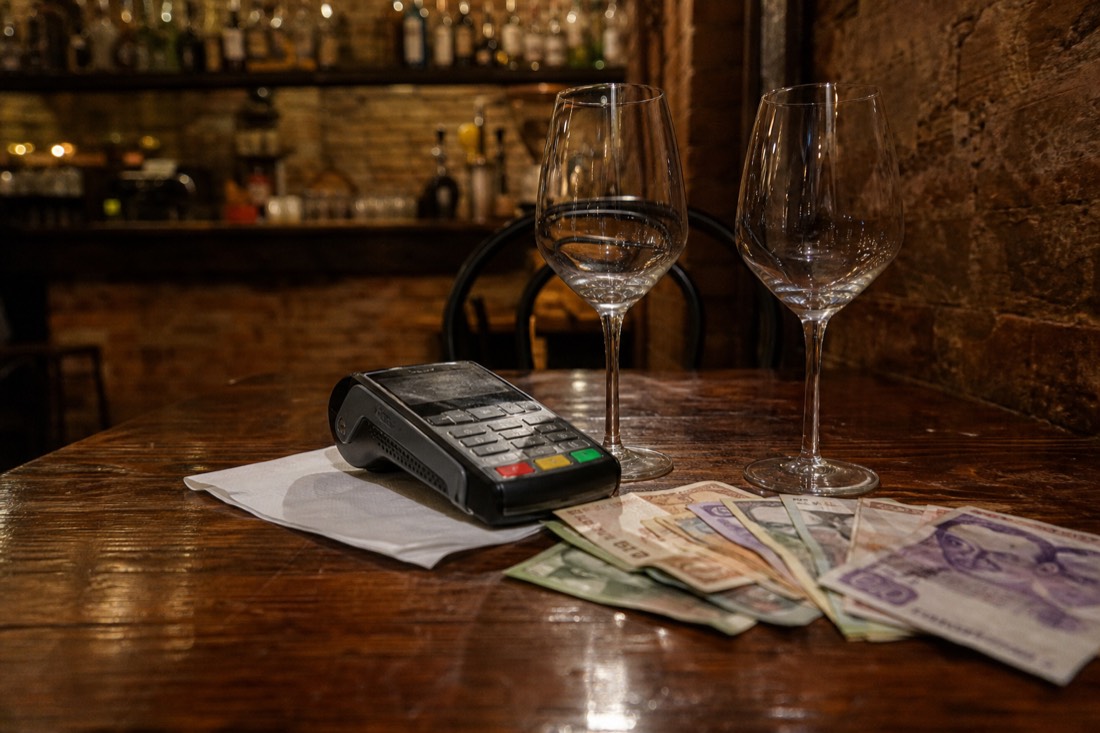
Item by item first. In a busy place a drink from the next table occasionally wanders onto your slip, and second rounds are the usual culprit because nobody remembers whether there were three beers or four. Count your own rounds as you go and the check takes no thought at all.
Then the service line. The percentage has to appear somewhere on the menu, so if the bill says 15% and the menu footer said 10%, you have a straightforward question to ask. The arithmetic is worth a glance too, since the charge may only be calculated on what you actually consumed, not on some house minimum, and not on a total that already includes itself. Self-service venues cannot levy it at all, which makes any service line at a canteen counter wrong on its face.
ÁFA, the VAT line, confuses visitors more than anything else on a Hungarian receipt. It is printed for information and is already inside the prices you read on the menu. It is not an addition, and a total that seems to have grown by the VAT amount is a total worth querying.
Last, look at what is missing. Borravaló, tip, should never be pre-printed. A bill that arrives with a tip line already filled in is not following the local pattern, and you are entitled to have it removed before you pay.
Which Situations Trip Guests Into Paying For Service Twice?
Double-tipping almost never comes from ignorance of the rule. It comes from five specific settings where the service charge is easy to miss: unread menu footers, English-translated bills, group settle-ups, hotel restaurants, and the habit of rounding up on a total that already carried the charge.
Gábor Kovács has guided international visitors around this city since 2022 and, by his own count, has hosted more than a thousand travellers, so he watches the same five scenes replay most weeks. The first is the menu footer. The charge is legally required to be declared, but declaration usually means one line in small type at the bottom of the last page, which nobody reads while hungry. Asking "van szervizdíj?" when you sit down costs one second and closes the whole question.
Second, translated bills. On an English printout the szervizdíj line often comes through as "service", which reads to a British or American visitor like a category heading rather than a charge already paid. Same number, entirely different meaning depending on which passport you carry.
Third, and this is the expensive one, group settle-ups. Six people split a bill that already carries a 12% charge, and three of them independently add 15% to their own share out of habit. Nobody notices, because each person only sees their own arithmetic. Say the words "the service is already on it" out loud to the table before anyone reaches for a card.
Fourth, hotel restaurants and dinner cruises, where the bill format is unfamiliar and the service line hides among room charges or package lines. Fifth, plain rounding. Rounding 11,400 forints up to 12,000 feels like nothing, and on a bill that already carries 15% it quietly makes the evening a 20% one. Gábor's own habit, and the one he passes on to guests, is simply this: read the service line first, decide once, then never think about it again for the rest of the meal. For the wider set of money mistakes that cluster near the tourist corridors, the dos and don'ts guide maps where they happen.
Is tipping included in Budapest restaurant bills?
Increasingly yes, as a printed szervizdíj (service charge) of 10-15%. When that line appears, no further tip is expected. When it does not, add 10-15% yourself at payment time.
What happens if I do not tip in Budapest?
Nothing dramatic. Tipping is customary, not compulsory, and Hungarians themselves skip it over a bill that already carries a service charge or after weak service. No one will chase you into the street.
Can I put a tip on my card in Budapest?
Yes. Since 2025 card tips can reach staff tax-free at properly run venues. Just state the total you want to pay before the server keys the amount into the terminal, as machines rarely prompt for a tip afterwards.
How much is the service charge in Budapest?
Typically 10-15% of the bill. By law it cannot exceed 15% for private diners, must be itemized separately on the receipt, and can only be calculated on what you actually consumed.
Choose Your Budapest Experience
Foodapest Market To Tavern. Traditional dishes, street-food tasters and wines with an English-speaking local guide. Have a date in mind? Check it before arranging the rest of your Budapest day.
180 minutes. Daytime option visits the market; the 17:00 option skips it. Notify the operator about vegetarian or vegan substitutions. Not suitable for coeliac requirements.
Choose a date to see scheduled departures. Final availability and price are confirmed on Viator.
No verified experience fits those requirements. Adjust your choices, or keep the independent plan described above.
Compare Options And Fit Your Plans
General recommendations until you choose. Sightseeing cruises use recorded commentary; the dinner cruise has no guide. All selected activities meet in central Pest; use the operator confirmation for the exact point and option.
- Carpe Diem District VII Food Walk: 150 minutes. Four Hungarian eateries, three drinks and an English-speaking guide through District VII. 150 minutes; meet outside the Orthodox Synagogue on Kazinczy utca. Vegetarian and alcohol-free options; no vegan or gluten-free diets.
- Hungarian Wine And Cheese Tasting: 90 minutes. Explore five Hungarian wines with a sommelier, artisan cheeses and charcuterie at a communal table. Ages 18 and over. Vegetarian alternatives require advance notice. The cellar is not wheelchair accessible; extra food and drinks cost separately.
- Budapest Culinary And Wine Walk: 300 minutes. Explore food markets and neighbourhoods with an English-speaking food specialist, tasting Hungarian dishes and wines along the way. Allow five hours and substantial walking. Current option is private; private transport and gratuities are excluded. Dietary arrangements require confirmation.
- Withlocals Private Food Tastings: 180 minutes. Explore Budapest with your own foodie host, with six or ten tastings and vegetarian alternatives on request. Allow 180 minutes for ten tastings; the six-tasting option is 120 minutes. Meet outside the Great Market Hall. No hotel pickup. Tell the host your dietary needs; vegan and coeliac suitability are not established.