Budapest Street Food: Lángos, Chimney Cake, and Where the Stands Cluster
The fried, the spiraled, and the smoked: how to eat standing up in Budapest without overpaying for any of it.
 Written with Gábor Kovács, Budapest local specialist and experience guide
Short answer
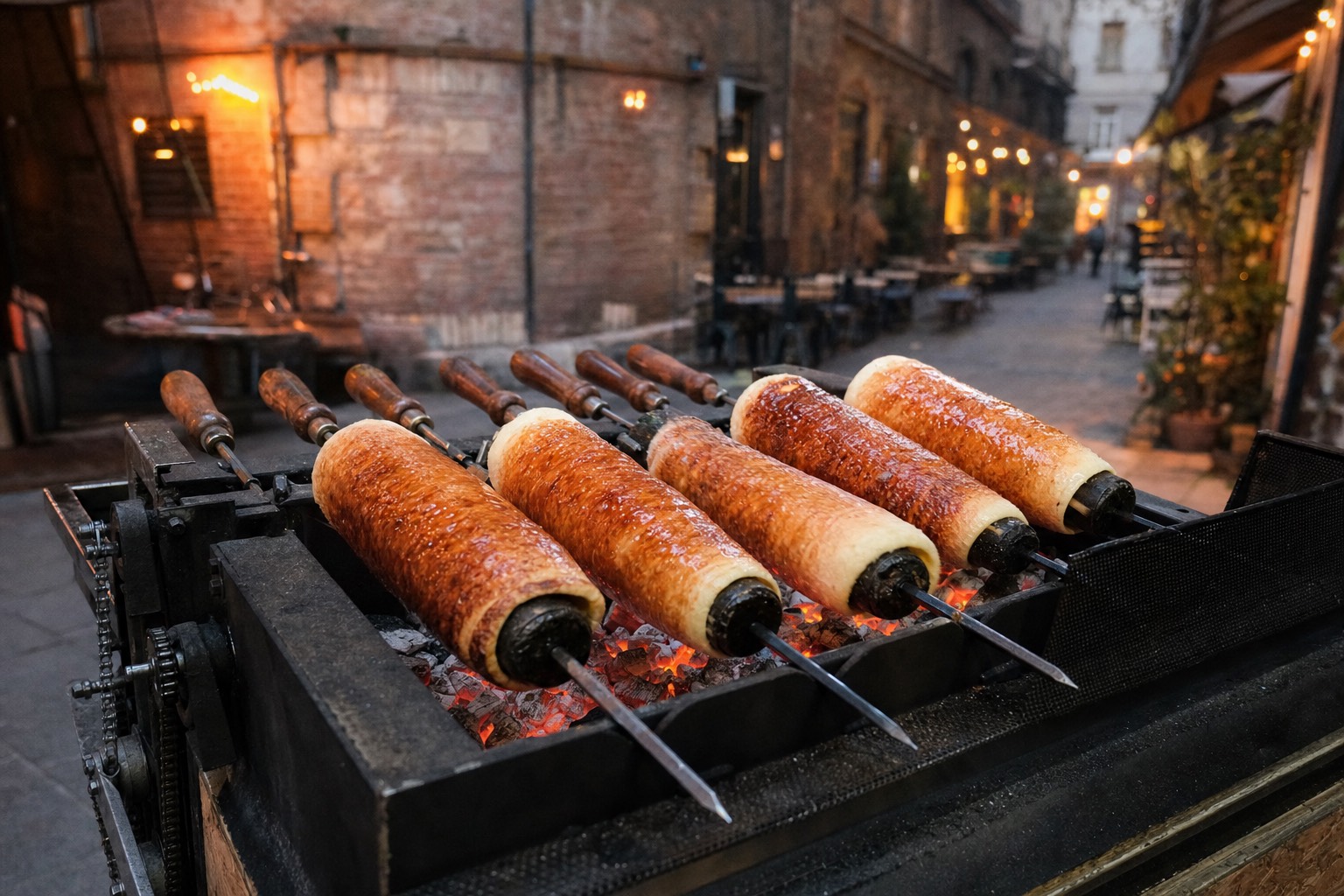
Budapest street food centres on lángos (deep-fried dough with sour cream and cheese), kürtőskalács (chimney cake, a Transylvanian-Hungarian spit pastry), and smoked sausages. Expect roughly 1,000 to 3,600 forints per item right now. The stands cluster at the Great Market Hall, the Karaván court on Kazinczy utca, and neighbourhood markets like Fény utca.
The smell hits before the stand does. Fried dough and garlic from one direction, caramelizing sugar from the other, and somewhere behind both, paprika smoke off a sausage grill. I have eaten standing up in this city my whole life, first as a kid gripping a lángos bigger than my head at the Fény utca market, now as someone who takes visitors past the tourist stands to the ones locals queue at. Budapest street food is short on variety and long on conviction: a handful of dishes, done a thousand ways, priced anywhere from pocket change to daylight robbery depending on where you stand. This guide sorts the dishes, the prices, and the geography.
Keep individual counters for quick snacks. If you want the food route arranged, Carpe Diem’s 150-minute walk includes lángos, Hungarian soup, a main course and dessert.
Booking choice: Carpe Diem combines four Hungarian eateries and three drinks in a 150-minute guided route. Explore Carpe Diem District VII Food Walk
What Street Food Is Budapest Famous For?
Three things above all: lángos, a plate-sized disc of deep-fried dough classically topped with garlic, sour cream and cheese; kürtőskalács, the spiral chimney cake roasted over coals; and grilled or smoked sausages. Strudel, roasted chestnuts in winter, and fried sausage-stuffed pastries fill out the supporting cast.
What Budapest does not have is the sprawling hawker culture of Bangkok or Mexico City, and it never pretends to. Street eating here grew out of market halls and fairgrounds, so the food is fairground food: hot, heavy, cheap in its natural habitat, and built to be eaten with your hands in cold weather.
That market-hall DNA matters when you plan. The best versions of almost everything in this guide live inside or beside markets, not on wheeled carts. A block of Váci utca will sell you the same dishes at double the price with half the care. The rule I give friends: eat street food where Hungarians outnumber the selfie sticks, and check my guide to Budapest food prices before you go so a 3,600 forint lángos registers as the premium it is rather than the norm.
What Is Lángos, And Where Do Locals Actually Eat It?
Lángos (LAHN-gosh) is a saucer of yeasted dough deep-fried until blistered, then rubbed with garlic and loaded, in its classic form, with sour cream and grated cheese. Locals eat it at market stands, at strandok (lidos) in summer, and increasingly at a few dedicated city shops.
The name comes from láng, flame, because the dough once baked at the mouth of the bread oven. The frying came later and stayed. A proper lángos arrives too hot to hold, needs both hands anyway, and counts as a full meal by any honest measure.
Where to get it separates tourists from locals fast. The stand I grew up with sits in the Fény utca market by Széll Kálmán tér, where Lángos Land currently charges 1,250 forints for the standard garlic version and 2,350 for the smoked cheese and sour cream one, weekday mornings to mid-afternoon. Downtown, Retro Lángos on Bajcsy-Zsilinszky út runs a loaded sour cream, cheese and red onion version at 3,290 forints with long daily hours, and the lángos vendor at the Karaván street food court on Kazinczy utca charges 3,600 for the classic in the middle of the ruin bar district. Same dish, nearly triple the price, and the gap is location, not quality. I wrote a whole love letter to lángos with more spots, but those three mark the price spectrum honestly.
Is Chimney Cake Czech Or Hungarian?
Hungarian. Kürtőskalács (KUR-tosh-kah-lach) comes from Transylvania's Hungarian-speaking Szekler communities and has centuries of history in Hungarian kitchens. The near-identical trdelník sold all over Prague is a modern street food import marketed to tourists, and the "old Bohemian tradition" framing is a marketing invention.
The confusion is understandable because Prague sells trdelník on every corner, harder than Budapest sells anything. But the family tree runs through Hungarian Transylvania, where kürtőskalács was a celebration bread, wound around a spit, rolled in sugar, and roasted over coals until the sugar lacquers into a crackling shell. The name means chimney cake because the hollow spiral, steaming from the middle, looks like a stovepipe.
A good one needs exactly that: real coals or serious radiant heat, sugar caramelized to glass, dough still steaming inside. A bad one is a microwaved bread tube with cinnamon dust. Budapest has both, and the specialist shops are worth seeking out; the Chimney Cake Workshop's Budapest guide keeps a running map of the dedicated bakeries. My own hunt for the city's best chimney cake ended with a walnut one eaten too fast outside a bakery window, which is the correct way.
What Is The Most Famous Hungarian Pastry?
On the street, kürtőskalács is the famous one, the pastry every visitor photographs and remembers. In the sit-down canon, rétes, the Hungarian strudel, is the homegrown classic, and Dobos torta, the caramel-topped layer cake, is the most famous invention of Hungarian pastry chefs.
The three occupy different worlds. Kürtőskalács belongs to fairs and street corners. Rétes is grandmother territory: tissue-thin stretched dough around sour cherry, sweet cheese (túró), apple, or cabbage, and yes, the savoury ones are wonderful. You will find honest rétes at market halls and old cukrászda (pastry shops), often for a few hundred forints a slice. Dobos torta lives in the grand cafés with chandeliers and tourists, and deserves its own afternoon.
If your time is short, the street logic is simple: chimney cake for the spectacle and the caramel crust, rétes when you pass a market counter with trays of it, Dobos when you sit down somewhere gilded. None of them will be the worst decision of your trip. Ordering a trdelník in Budapest, however, is impossible, and mentioning one approvingly near a Hungarian baker is inadvisable.
How Much Does Street Food Cost In Budapest Right Now?
Roughly 1,000 to 3,600 forints per item at the moment. A classic chimney cake runs 990 to 1,800 forints depending on the shop, specialty versions reach 3,600, and lángos spans 1,250 at a neighbourhood market to 3,600 in the party district. Location moves the price more than the food does.
Here is the current spread among well-known chimney cake makers, drawn from the specialist bakeries' own listed prices:
| Chimney cake | Where | Current price |
|---|---|---|
| Molnár's, classic traditional | Váci utca 31 | 990 Ft |
| Fitzkey, chimney cake (vegan options noted) | Downtown | 1,200 Ft |
| Pichler, traditional | Kossuth Lajos utca 4 | 1,800 Ft |
| Pichler, specialty versions | Kossuth Lajos utca 4 | 2,500 to 3,600 Ft |
And the lángos picture, where Time Out Budapest's lángos survey matches what I see on the boards:
| Lángos | Where | Current price |
|---|---|---|
| Standard with garlic | Lángos Land, Fény utca market | 1,250 Ft |
| Smoked cheese + sour cream | Lángos Land, Fény utca market | 2,350 Ft |
| Sour cream, cheese + red onion | Retro Lángos, Bajcsy-Zsilinszky út 25 | 3,290 Ft |
| Classic | Karaván, Kazinczy utca 18 | 3,600 Ft |
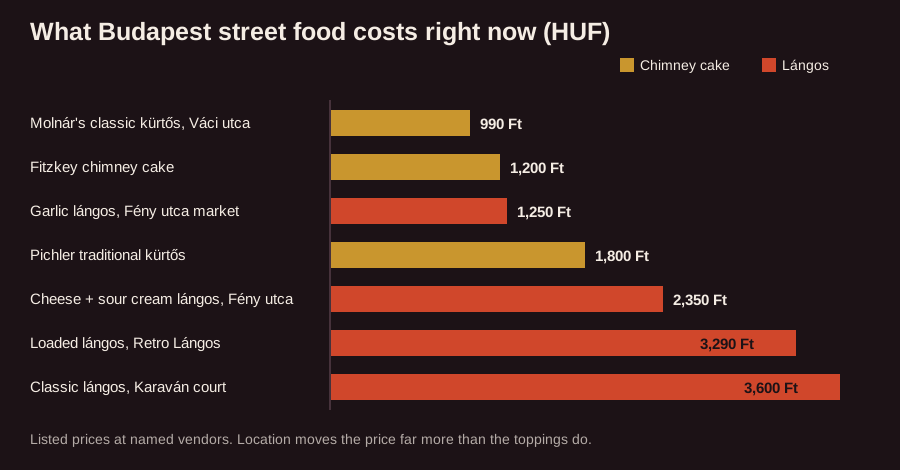
Fitzkey deserves a note for travellers with dietary limits: it is one of the few chimney cake makers with proper vegan options, a point its TripAdvisor page reviewers make repeatedly.
Where Do The Street Food Stands Cluster?
Three clusters cover nearly everything: the Great Market Hall at Fővám tér for lángos, strudel and sausages under one roof; the Karaván food court at Kazinczy utca 18 in the ruin bar district for late-night everything; and neighbourhood markets like Fény utca for local prices and zero tourists.
| Cluster | What it does best | When to go |
|---|---|---|
| Great Market Hall, Fővám tér | Lángos gallery upstairs, sausage and strudel counters | Weekday mornings; closed Sundays |
| Karaván, Kazinczy utca 18 | Lángos, burgers, chimney cake beside the ruin bars | Evenings; open past 23:00, till midnight Thu to Sun in winter |
| Fény utca market, Lövőház utca 12 | The local-price lángos experience | Tue to Sat, mornings to early afternoon |
| Downtown corners, Váci and Kossuth Lajos utca | Chimney cake shops with long hours | Whenever the craving hits |
The upstairs gallery of the Great Market Hall is the single best first stop: everything in this guide within fifty metres, plus paprika and salami stalls below. Karaván works the opposite shift, feeding the ruin bar crowd next to Szimpla Kert into the small hours.
What About Hungarian Sausages And The Meat Counters?
Hungarian sausage culture runs on kolbász, the paprika-red smoked sausage, sold grilled at stands or dried at market counters, alongside hurka, a soft rice-and-liver or blood sausage. At markets you order by pointing, pay by weight for the dried kind, and get mustard and bread with the grilled kind.
Kolbász (KOL-bahss) is the word to know. Grilled fresh, it is fairground food, blistered and served with a slab of white bread and a squeeze of mustard. Smoked and dried, it becomes a souvenir that survives a suitcase, and the market counters will happily vacuum-seal it. The gyulai and csabai styles, both from sausage towns in the southeast, are the names worth remembering on a label.
Hurka comes in májas (liver and rice) and véres (blood and rice) versions. These traditional sausages are a useful addition to an independent counter-food itinerary for visitors who enjoy offal.
How Do You Build A Street Food Day Without Wrecking Your Appetite?
Pace it like a local: one savoury anchor before noon, walking distance between bites, and sugar last. Lángos or sausage mid-morning at a market, rétes as an afternoon comma, chimney cake after dark when the coals and the string lights do their work. Two big items a day is plenty.
Street food here is heavy, and the classic tourist error is stacking lángos, chimney cake and a sausage into the same two hours, then facing a goulash dinner with regret. Spread it out. A market morning on the Buda side, a bridge walk, the Great Market Hall gallery for a late lunch bite, then Kazinczy utca in the evening covers the whole canon in one honest day, with the district's bars as a built-in digestif.
Winter changes the calculus in the street food's favour: roasted chestnuts appear on corners, mulled wine stands multiply, and a hot chimney cake in cold air is one of the city's genuine pleasures. Summer moves the action to the lidos and lake spots where lángos rules unchallenged. There is no bad season, only bad sequencing.
What Does A Street Food Crawl Look Like, Stop By Stop?
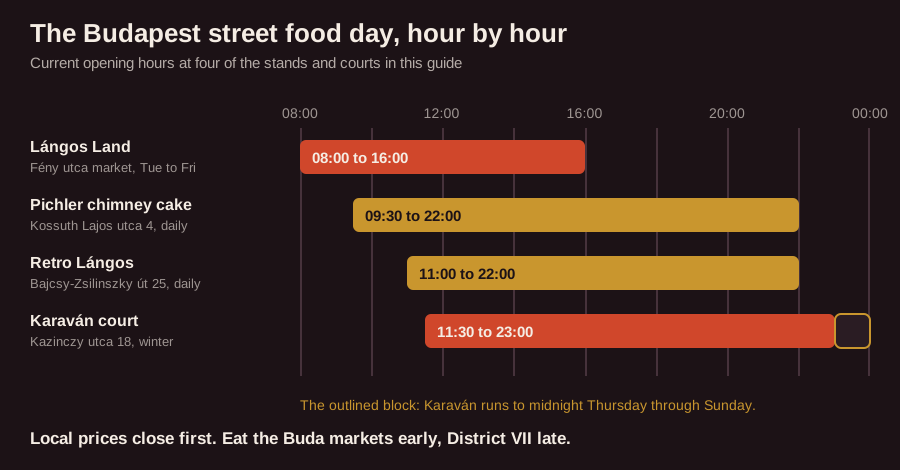
Follow the opening hours rather than the map. Neighbourhood markets like Fény utca run mornings only, the Great Market Hall closes on Sundays, and the Karaván court on Kazinczy utca opens at 11:30 and runs to 23:00, or midnight from Thursday to Sunday in winter. That sequence writes itself.
Here is the crawl I hand to visitors who want one honest day rather than a checklist. It starts on the Buda side because the local-price stands close first, and it finishes in District VII because that is the only cluster still frying at night.
Treat every time below as an allowance rather than a schedule. Queues, tram connections and one long conversation at a counter will each eat a chunk of it, and the day works better with slack in it.
| Stop | What to order | Allow about | Why here |
|---|---|---|---|
| Fény utca market, Lövőház utca 12 | Garlic lángos, 1,250 Ft | 45 minutes | Local prices, morning hours only, Tue to Sat |
| Walk down to the river and cross | Nothing, deliberately | 40 minutes | The gap that keeps the next stop enjoyable |
| Great Market Hall, Fővám tér | Sausage counter downstairs, strudel upstairs | An hour | Everything under one roof, closed Sundays |
| Afternoon pause, anywhere with coffee | Rétes by the slice if you pass a tray | 30 minutes | The savoury half is done by now |
| Kazinczy utca 18, Karaván | Chimney cake, or a second lángos if you skipped one | An hour or more | Coals, evening light, bars either side |
The gap in the middle is the part people delete and then regret. Lángos is fried dough the size of a dinner plate, and it does not share a stomach politely with a sausage eaten forty minutes later. Walking between the Buda market and Fővám tér is roughly the right amount of nothing.
One adjustment for Sundays: the Great Market Hall is shut, so the middle of the crawl moves to the downtown chimney cake windows on Kossuth Lajos utca and Váci utca, both of which keep long daily hours, and the evening stays where it is. My three day food itinerary folds this crawl into a wider plan if you have more than one day to spend.
How Do You Tell A Fresh Kürtőskalács From A Reheated One?
Watch the spit, not the display case. A fresh chimney cake comes off a rotating rack still steaming, and its caramel shell crackles audibly when you twist the spiral apart. A reheated one is soft, quiet and evenly warm. Lángos should reach the counter blistered, straight from the oil, never lifted off a stack.
I have eaten a lot of both, and the tells are physical rather than a matter of taste. For kürtőskalács, look behind the counter first. You want to see dough wound on wooden spits turning over heat, and you want a rack of them at different stages of colour. If the only thing behind the glass is a row of finished cakes in paper sleeves, the sugar shell has already gone from glass to chew. The second test is sound. A fresh one resists slightly, then gives with a crack. A tired one just tears.
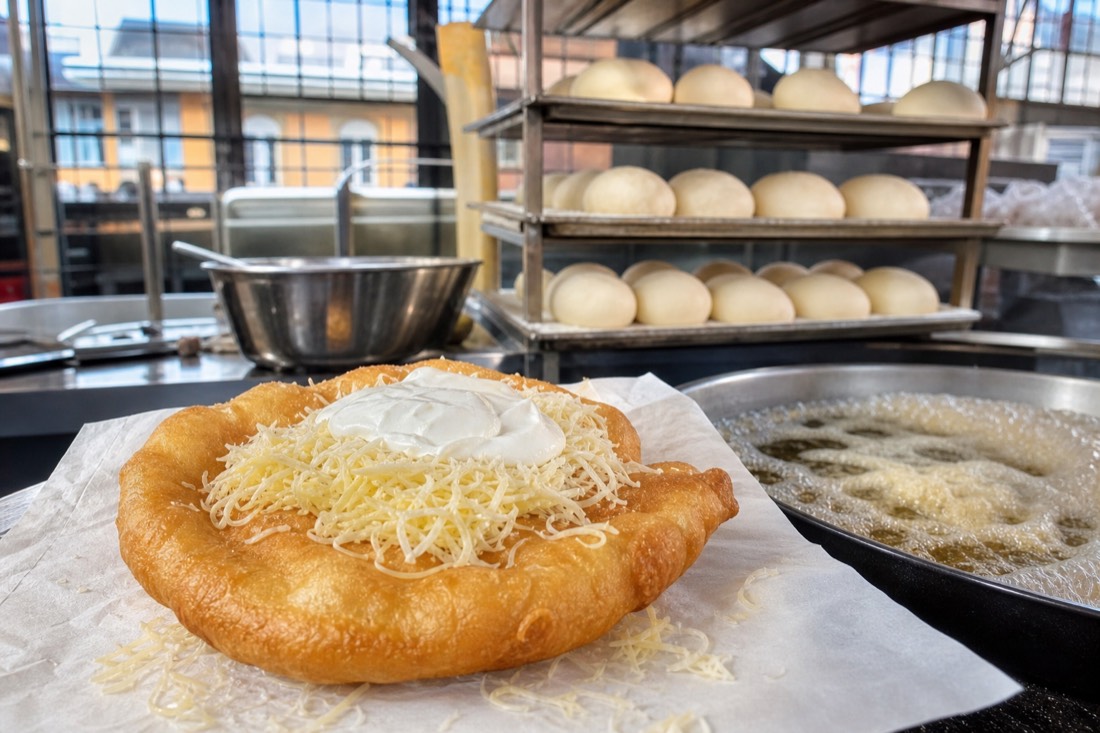
Lángos is easier still. The dough should be stretched and dropped into the oil after you order, which means a short wait and a disc that arrives too hot to hold. If it comes off a pile under a lamp, the outside has gone leathery and the toppings sit on a surface that will not melt them. That is the giveaway: on a fresh one, grated cheese slumps within seconds against the heat, and the sour cream spreads instead of sitting up in a scoop.
Both dishes reward the same instinct, which is to look at turnover before you look at the sign. A queue at a stand that fries or bakes to order is a good queue. A queue at a warming cabinet only means other people made the same mistake earlier.
| What you can see | Fresh | Sitting too long |
|---|---|---|
| Kürtőskalács rack | Spits turning, cakes at different colours | A finished row in paper sleeves |
| Chimney cake shell | Cracks when you twist the spiral | Bends and tears silently |
| Lángos timing | Dough goes in the oil after you order | Lifted off a stack under a lamp |
| Lángos surface | Blistered, uneven, steam escaping | Flat, matte, slightly leathery |
| Toppings | Cheese slumps on contact | Cheese stays dry and separate |
What Should You Budget For Street Food Compared With A Sit-down Meal?
Street food is the cheap half of Budapest eating, provided you buy it where locals do. A garlic lángos runs 1,250 forints at the Fény utca market and 3,600 forints at the Karaván court, and a classic chimney cake spans 990 to 1,800 forints. A restaurant bowl of gulyás currently runs about €6 to €10.
The useful way to hold this in your head is not a per-item price but a pair of daily allowances, because the same two items cost wildly different money depending on which part of the city you happen to be standing in when hunger arrives.
Neighbourhood prices first. A garlic lángos at Lángos Land and a classic kürtős at Molnár's come to a shade over 2,200 forints together, which is a full, heavy lunch for the price of a coffee and a pastry in most European capitals. Move the same two purchases downtown, to Retro Lángos and Pichler's traditional cake, and you are past 5,000. Buy them in the ruin bar district at midnight, with a specialty chimney cake, and you can clear 7,000 forints for two items eaten standing up.
None of those numbers are unfair, exactly. Rent on Kazinczy utca is not rent at a Buda market, and the party district charges for being open when nothing else is. But it does mean street food stops being the budget option well before you notice, and it is why a sit-down bowl of gulyás at €6 to €10 can undercut a lángos bought two streets from Szimpla. My full breakdown of Budapest food prices covers the restaurant side properly.
| Where you buy | The same two items | What it comes to |
|---|---|---|
| Neighbourhood market | Lángos Land garlic lángos plus Molnár's classic kürtős | Roughly 2,200 Ft |
| Downtown streets | Retro Lángos loaded lángos plus Pichler traditional | Roughly 5,100 Ft |
| Ruin bar district, late | Karaván classic lángos plus a specialty chimney cake | Up to about 7,200 Ft |
| Sit-down comparison | A restaurant bowl of gulyás with bread | About €6 to €10 |
What Do You Do When The Queue Is Twenty Deep?
Shift an hour, or shift a stand. Queues here peak in narrow, predictable windows: the market halls around midday, the downtown chimney cake windows on weekend evenings, and Karaván once the bars around it fill. Every cluster has a second counter selling the same thing to a shorter line.
The clusters do not share a rhythm, which is the whole opportunity. Fény utca is busiest when Buda does its shopping and then simply closes for the day. The Great Market Hall fills with coach groups from late morning, so the gallery counters upstairs are calm early and chaotic by one o'clock. Karaván barely exists before noon and then absorbs the ruin bar overflow from mid-evening onwards, running to 23:00 early in the week and to midnight Thursday through Sunday in winter. Pichler on Kossuth Lajos utca keeps daily hours from 9:30 to 22:00, which makes it the reliable fallback when the market timing has gone wrong.
A queue is also information, and it is worth reading before you join it. At a stand that fries or bakes to order, a line is the best thing you can see, because it means constant turnover and nothing sitting. At a stand selling from a warming cabinet, the same line tells you only that the location is good. That distinction saves more disappointment than any list of addresses.
If the queue is too long for your available time, try a different counter and share tastes within your group. Keep enough time to eat before the next booked activity.
Is Budapest street food safe to eat?
Yes, comfortably. Stands at markets and established courts like Karaván operate under normal Hungarian food inspection, turnover is fast, and everything in this guide is cooked hot to order. Use the universal rule anyway: queues of locals are the best hygiene certificate on earth.
Can I pay by card at street food stands?
Almost everywhere now, including market stalls and the Karaván vendors. Carrying 5,000 to 10,000 forints in cash still helps at the smallest neighbourhood market counters, and prices are always marked in forints, not euros. If a stand quotes you euros, walk on.
What is the single best first street food to try?
A classic sour cream and cheese lángos at a market stand, eaten immediately, standing up. It is the most Hungarian thing you can do with your hands for under 2,500 forints, and it recalibrates what fried dough is allowed to taste like.
Choose Your Budapest Experience
Carpe Diem District VII Food Walk. Four Hungarian eateries, three drinks and an English-speaking guide through District VII. Have a date in mind? Check it before arranging the rest of your Budapest day.
150 minutes. 150 minutes; meet outside the Orthodox Synagogue on Kazinczy utca. Vegetarian and alcohol-free options; no vegan or gluten-free diets.
Choose a date to see scheduled departures. Final availability and price are confirmed on Viator.
No verified experience fits those requirements. Adjust your choices, or keep the independent plan described above.
Compare Options And Fit Your Plans
General recommendations until you choose. Sightseeing cruises use recorded commentary; the dinner cruise has no guide. All selected activities meet in central Pest; use the operator confirmation for the exact point and option.
- Downtown Chimney-Cake Workshop: 60 minutes. Shape, bake and season three chimney cakes, then take the recipe and your cakes home. Age 7+. Meet inside Kató Néni Finomságai, Október 6. utca 6. Basement workshop; not wheelchair accessible. Vegan dough; confirm toppings and any allergies.
- Private Coffee And Cake Walk: 150 minutes. Discover Budapest’s grand cafés, neighbourhood confectioneries and strudel shops with a private local guide. Confirm the pickup point with the operator. Coffee and dessert stops form the experience; dietary suitability and specific cafés need confirmation.
- Foodapest Market To Tavern: 180 minutes. Traditional dishes, street-food tasters and wines with an English-speaking local guide. Daytime option visits the market; the 17:00 option skips it. Notify the operator about vegetarian or vegan substitutions. Not suitable for coeliac requirements.