Lángos: The Fried Bread That Runs This City
A Budapest local's love letter to lángos, the garlicky fried bread, with the classic toppings, real 2026 prices, and where the queues are worth joining.
 By Gábor Kovács, Budapest local specialist and experience guide
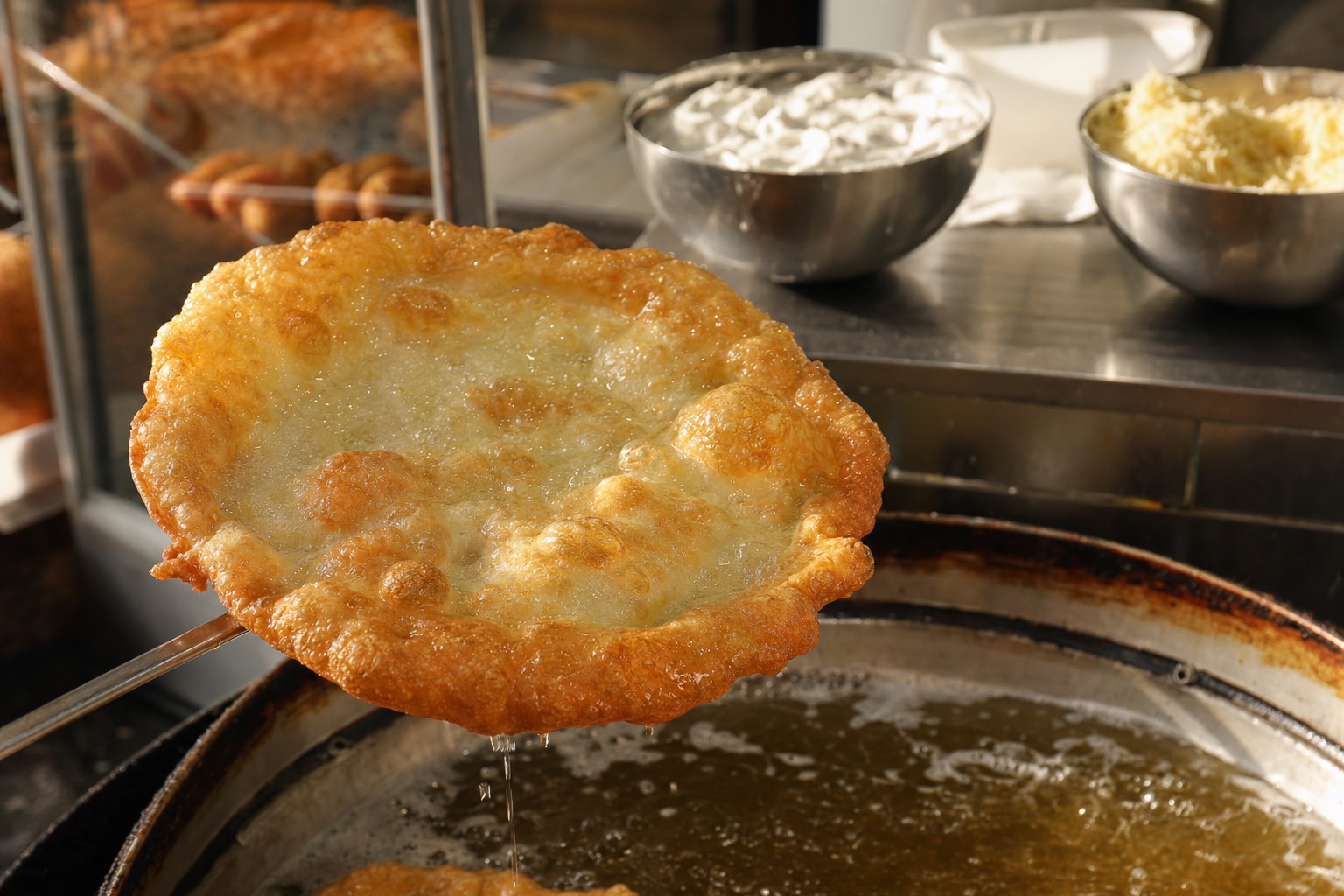
There is a sound lángos makes when it hits the oil, a fast hiss that collapses into a steady bubble, and I would know it blindfolded. Lángos (pronounced roughly LAHN-gosh, a disc of deep-fried bread dough) is not fine dining and has never pretended to be. It is what you eat at the beach, at the market, at 2 AM, after swimming, before drinking, during heartbreak. Every Hungarian has a personal history with it. This is mine, and also a practical map for yours.
Use the street-food advice below to find a fresh lángos. A dedicated class lets you take its dough and frying techniques home.
Booking choice: Make classic and potato lángos with different toppings in a hands-on class, with drinks and recipes. Explore Lángos-Making Class With Chef Marti
What Exactly Is Lángos?
Lángos is yeasted bread dough, often with a little potato or sour cream worked in, stretched flat and deep-fried until it blisters gold. The classic dressing is a rubbed cut clove of garlic or garlic water, then sour cream and grated cheese. It arrives hot, heavy, and roughly the size of your face.
The name comes from láng, meaning flame, because the original version baked at the mouth of a wood-fired bread oven while the family loaf did its slow work inside. Frying came later and conquered everything. What survived from the oven days is the spirit: lángos is what you make from bread dough when you are hungry now, not in three hours.
The texture is the point. A proper one is crisp and blistered at the rim, tender and slightly chewy in the middle, and glossy with garlic. It should flop when you hold it by one edge. Stiff lángos is old lángos.
Why Do Hungarians Love It So Much?
Because it is tied to every good memory involving summer. Lángos is the official food of Lake Balaton beaches, village fairs, and market mornings, which makes it less a snack than a national ritual. The garlic-sour-cream-cheese version is as fixed in Hungarian life as the paprika on a goulash.
My own file of memories: standing dripping wet at a Balaton beach counter at age eight, being told to hold it with both hands. Saturday mornings upstairs at the market with my grandmother, who considered lángos an acceptable breakfast if you had walked there. Late nights in District VII when the only honest food within reach was a fried disc with extra garlic.
You can taste this history anywhere in the country, but the market-stall version is the Budapest baseline. If you are building a wider eating list, my what to eat in Budapest guide puts lángos in its full context, right after the soups and before the desserts.
What Are The Classic Toppings?
Sajtos-tejfölös, cheese with sour cream, is the classic and the correct first order. The canon then extends to red onion, crispy fried onion, bacon, roasted sausage, and newer moves like goat cheese with spring onion. Garlic is not a topping, it is the foundation, applied before anything else lands.
The menu at a serious lángos counter reads like a small language lesson, so here is the decoder:
| On the menu | Say it | What lands on your bread |
|---|---|---|
| Sima | SHE-mah | Plain, garlic only, the purist's order |
| Tejfölös | TEY-fuh-luhsh | Sour cream |
| Sajtos-tejfölös | SHOY-tosh TEY-fuh-luhsh | Sour cream and grated cheese, the classic |
| Hagymás | HODJ-mash | With red onion or crispy fried onion |
| Baconös / kolbászos | as it looks | Bacon, or rounds of roasted sausage |
Those variations are not my invention; the topping canon, from the sour cream baseline through bacon, roasted sausage and goat cheese with spring onion, is exactly what the menu at Retro Lángos, one of the city's best-known counters, lists on TripAdvisor.
One warning from experience: toppings obey diminishing returns. Two is plenty. A lángos buried under five ingredients is a soggy pizza with regrets.
What Does Lángos Cost In 2026?
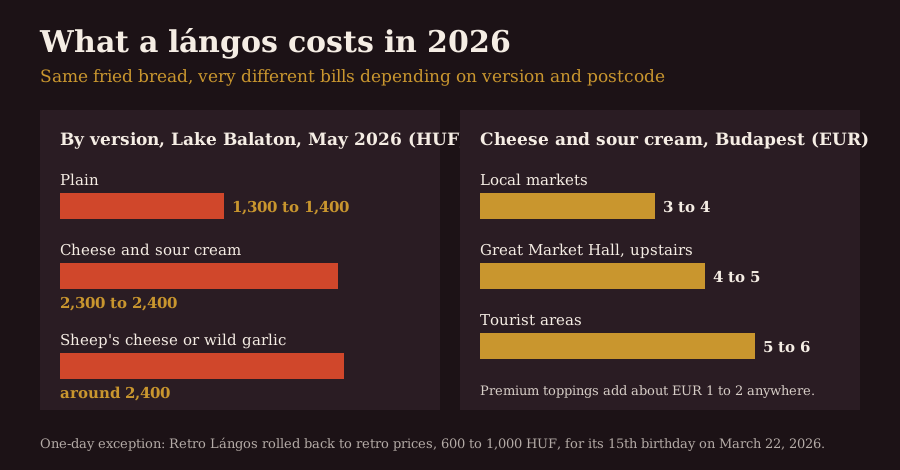
In Budapest, a basic sour cream and cheese lángos runs about EUR 3 to 4 at local markets and EUR 5 to 6 in tourist zones, with premium versions adding EUR 1 to 2. At Lake Balaton this season, plain cost 1,300 to 1,400 HUF and the classic cheese version 2,300 to 2,400 HUF.
Prices have been a national talking point lately, because lángos inflation is the kind Hungarians actually feel. The current numbers, tracked by DAIZ Trip's 2026 Budapest food price survey and Daily News Hungary's Balaton report, sketch the landscape:
| Where | Plain | Cheese and sour cream | Premium versions |
|---|---|---|---|
| Budapest local markets | EUR 3 to 4 | plus EUR 1 to 2 | |
| Budapest tourist areas | EUR 5 to 6 | plus EUR 1 to 2 | |
| Great Market Hall, upstairs stalls | EUR 4 to 5 | ||
| Lake Balaton, May 2026 | 1,300 to 1,400 HUF | 2,300 to 2,400 HUF | sheep's cheese or wild garlic around 2,400 HUF |
Read that table the way a local does: the same fried disc nearly doubles in price between a neighborhood market and a stand fifty meters from a sight. The bread does not get better. The rent does. My Budapest food prices guide runs this logic across the whole menu.
Where Do Locals Actually Queue?
At Retro Lángos on Bajcsy-Zsilinszky út, a counter so loved it celebrated its 15th birthday in March 2026 by selling lángos at its old 600 to 1,000 forint retro prices for a day. The other reliable local move is the upstairs stalls of the Great Market Hall, eaten standing at the rail.
Retro Lángos is the proof that a fried-bread counter can become an institution. For its fifteenth birthday on March 22, 2026, it rolled prices back for one day, and the numbers were a small time machine:
| Birthday menu, March 22, 2026 | Retro price |
|---|---|
| Plain lángos | 600 HUF |
| Cheese and sour cream | 800 HUF |
| Hungarian and rustic loaded versions | 1,000 HUF |
The queue that day was its own city event. On a normal day you will still wait, and you should.
The market hall option comes with a bonus: the theater of the building itself. Go early for the quiet version of the hall, the one I wrote about in my morning at the Great Market Hall, do your shopping, then be near the gallery stalls when they hit their stride.
How Do You Eat One Without Ruining Your Shirt?
Flat hold, two hands, lean forward. Keep the disc parallel to the ground, start at the edge and work inward, and let the fold come only in the final third. Napkins go in your non-dominant hand from the start, not fetched later. Nobody eats a loaded lángos gracefully; the goal is only containment.
There is a physics to it. Sour cream migrates. Cheese slides on the sour cream. The garlic oil underneath is the lubricant for the whole disaster. The lean is what saves you: your shirt should never be under the lángos, only your shoes, and shoes wipe clean.
Order a cold drink with it. The traditional pairing at the beach is a kefir-adjacent buttermilk or just a lemonade; at the market, whatever is nearest. Beer works. Wine, honestly, also works, which surprises visitors until they try it.
Is Market Lángos Better Than Beach Lángos?
They are different foods wearing the same dough. Market lángos is bigger, cheaper, and eaten standing in noise; beach lángos at Balaton costs more but comes with lake air and the taste of summer holidays. In Budapest you get the market version, and eaten before ten in the morning it has no equal.
I refuse to fully rule on this, the way you refuse to rank your children. But I will say this: the market version is the one you can have tomorrow. Get there hungry, order sajtos-tejfölös with extra garlic, find a spot at the rail, and lean forward. Somewhere behind you a new batch is hitting the oil. That hiss is the sound of this city feeding itself, and now it is feeding you too.
Choose Your Budapest Experience
Lángos-Making Class With Chef Marti. Make classic and potato lángos with different toppings in a hands-on class, with drinks and recipes. Have a date in mind? Check it before arranging the rest of your Budapest day.
120 minutes. Booking age bands start at 13. Meet at Hajós utca 14. Equipment and ingredients included; confirm dietary needs and toppings with the chef.
Choose a date to see scheduled departures. Final availability and price are confirmed on Viator.
No verified experience fits those requirements. Adjust your choices, or keep the independent plan described above.
Compare Options And Fit Your Plans
General recommendations until you choose. Sightseeing cruises use recorded commentary; the dinner cruise has no guide. All selected activities meet in central Pest; use the operator confirmation for the exact point and option.
- Carpe Diem District VII Food Walk: 150 minutes. Four Hungarian eateries, three drinks and an English-speaking guide through District VII. 150 minutes; meet outside the Orthodox Synagogue on Kazinczy utca. Vegetarian and alcohol-free options; no vegan or gluten-free diets.
- Foodapest Market To Tavern: 180 minutes. Traditional dishes, street-food tasters and wines with an English-speaking local guide. Daytime option visits the market; the 17:00 option skips it. Notify the operator about vegetarian or vegan substitutions. Not suitable for coeliac requirements.