Hungarian Food: What Hungarians Actually Eat, and Why Paprika Rules It
Hungarian cooking is a system, not a list of dishes. Here is how the cuisine actually works: the paprika backbone, the dish families, the regions and the customs at the table.
 Written with Gábor Kovács, Budapest local specialist and experience guide
Short answer
Hungarians eat a paprika-centered cuisine built on slow-cooked meat stews (pörkölt and paprikás), hearty soups eaten before every main meal, thick vegetable dishes called főzelék, sour pickles, freshwater fish, and rich desserts. Onions cooked in fat plus ground paprika form the base of most savory dishes, and sour cream softens the heat.
Ask a Hungarian what our food is and you will not get a list, you will get a method. My mother never measured paprika in her life. Onions go into fat, the pot comes off the heat, the red powder goes in, and the smell that fills the stairwell is the actual national anthem. This page is the cuisine from the inside: how it is built, why paprika sits at the center, and how eating is organized from region to region. For the specific dishes to hunt down in the capital, the what to eat in Budapest guide has that list; this one explains the kitchen behind it.
Use the dish families to recognise what is on a menu. A local-home cooking class turns that introduction into a meal you prepare, while a food walk gives you more dishes to compare.
Booking choice: The four-hour local-home class includes ingredients, equipment and recipes, with a market visit in the morning option. Explore Hungarian Cooking In A Local Home
What Kind Of Food Do They Eat In Hungary?
Hungarians eat a hearty Central European cuisine organized around paprika, pork and beef, onions cooked slowly in fat, sour cream, and seasonal vegetables served as thick stews or pickles. Meals lean on soup as a first course, slow-simmered mains, and an unapologetic dessert tradition. It is peasant cooking refined over centuries, not spicy by default.
The foundation is a technique, not an ingredient list. Nearly every savory classic starts the same way: onions sweated in fat, traditionally lard, then the pot pulled from the flame so ground paprika can bloom in the fat without burning. Burnt paprika turns bitter, which is why the pause matters. Onto that red base go meat for pörkölt (the true Hungarian stew), more liquid for soups, or sour cream for the paprikás family.
Around that core sit the supporting players: nokedli (small pinched dumplings), fresh white bread at every meal, savanyúság (sour pickled vegetables) served alongside rich mains as the acid counterweight, and river fish where the water allows. Beef, pork and chicken carry the savory canon. Game shows up in autumn. And the sweet tooth is serious: layered cakes, strudels and dumplings are treated as achievements, not afterthoughts.
Why Is Paprika At The Center Of Hungarian Cooking?
Because it is the cuisine's identity, economy and color in one. Paprika arrived via the Ottoman era, was bred sweet in the south around Szeged and Kalocsa, and became the defining spice of the national kitchen. It still earns real money: fresh and dried paprika exports brought Hungary 40.7 million euros in 2024.
That export figure, reported by the agricultural trade platform Tridge, says something important: paprika is a living agricultural sector here, not a museum piece. Food overall accounted for about 9 percent of Hungary's merchandise exports in 2024, per World Bank data on Trading Economics, and the red powder is its most famous ambassador.
What visitors misunderstand is the range. Hungarian paprika is a family of grades, most of them gentle:
| Grade | Hungarian name | Character |
|---|---|---|
| Noble sweet | Édesnemes | The default: deep red, fragrant, mild |
| Delicate | Csemege | Mild, fuller-bodied, everyday cooking |
| Hot | Csípős / Erős | Real heat, added by the pinch |
| Smoked | Füstölt | Smoke-dried, used sparingly |
| Rose | Rózsa | Paler, lighter aroma |
Everyday cooking runs on the sweet grades. Heat is personal and added at the table, usually as a hot paprika paste passed around like salt. If you want to bring some home, buy tins marked with the Szeged or Kalocsa origin, the two southern towns whose names function as quality shorthand. The paprika shopping notes cover grades, fakes and prices stall by stall.
How Is A Hungarian Meal Structured?
The traditional main meal is midday, and it opens with soup, almost without exception. Then comes a cooked main with bread and pickles, then dessert if the day deserves it. Dinner is lighter, often cold. Sunday lunch remains the anchor of family eating, and its menu barely changes between households.
Soup first is the custom that outlasts all others. Weekdays it might be a light vegetable or caraway broth; Sundays it is húsleves, a golden meat consommé with thin vermicelli, followed by the boiled meat from the pot as part of the main course. Skipping soup at a family table registers somewhere between eccentric and insulting.
The other structural habit is the acid balance. Rich, fatty, paprika-heavy mains are always paired with something sour: cucumber salad in vinegar, pickled peppers, sauerkraut. It is why a Hungarian plate rarely feels as heavy in the mouth as it reads on paper. Visitors who find the cuisine "too much" have usually been served the stew without its pickle.
What Are The Main Dish Families?
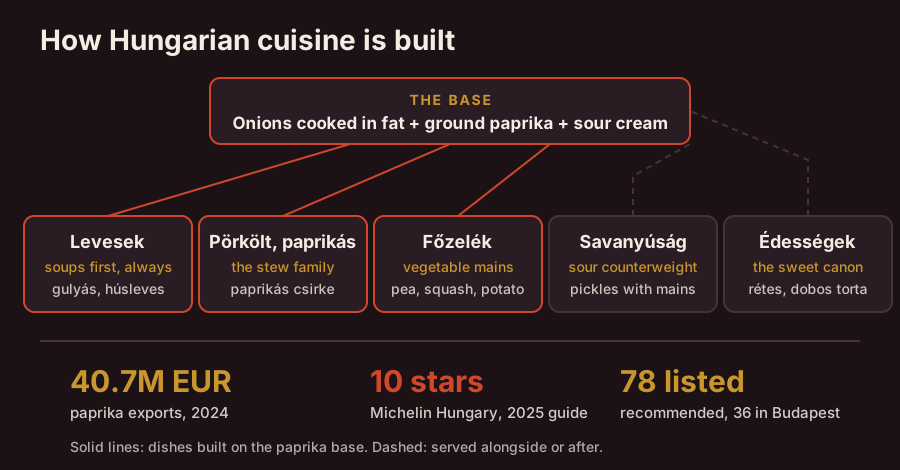
Five families cover most of the cuisine: levesek (soups, from light broths to meal-sized gulyás), pörkölt and paprikás (the stew family, dry or creamed with sour cream), főzelék (thick vegetable stews eaten as mains), savanyúság (pickles as a standing side dish), and the dessert canon of strudels, layered cakes and sweet dumplings.
| Family | What it means | Signature examples |
|---|---|---|
| Levesek (soups) | First course of every proper meal, sometimes the whole meal | Húsleves, gulyás, halászlé, hideg meggyleves (cold sour cherry soup) |
| Pörkölt and paprikás | Slow paprika stews; paprikás adds sour cream | Marhapörkölt (beef), paprikás csirke, borjúpaprikás |
| Főzelék | Thick vegetable dishes served as a main with a topping | Pea, squash, potato, spinach főzelék |
| Savanyúság | Sour pickles as the standing counterweight | Cucumbers, pickled peppers, sauerkraut |
| Desserts | Cakes, strudels, dumplings taken seriously | Rétes (strudel), dobos torta, túrógombóc, somlói galuska |
Two of these families are nearly invisible to tourists. Főzelék is the true weekday lunch of the country, cheap, vegetable-forward and sold in dedicated canteens, and it quietly makes Hungary friendlier to vegetarians than its reputation suggests; the vegetarian Budapest guide builds on exactly that. Savanyúság barely registers as a "dish" at all, yet no local table is complete without it. Meanwhile gulyás, the one dish everyone knows, is technically a soup in the levesek family, a point the goulash guide settles in detail.
Do The Regions Eat Differently?
Yes, noticeably. The Great Plain is herdsman country and the home of gulyás cooked in kettles. The south around Szeged and Kalocsa grows the paprika and cooks the spiciest fish soup. Tokaj in the northeast is sweet-wine country. Lake Balaton means freshwater fish, and the northwest leans toward Austrian-inflected cooking.
| Region | What defines the table |
|---|---|
| Great Plain (Alföld) | Herdsman cooking: kettle gulyás, mutton, dry sausages |
| Szeged and Kalocsa (south) | Paprika fields, fiery halászlé, spiced salami tradition |
| Tokaj (northeast) | Aszú dessert wines, dry furmint, wine-cellar food |
| Lake Balaton | Fried hekk, fogas (pikeperch), summer beach lángos |
| Northwest (Transdanubia) | Lighter, Austrian-touched cooking, dairy and game |
For a visitor based in the capital, the practical meaning is this: Budapest is where the regions converge. The wine list carries Tokaj and the volcanic Balaton highlands, the fish soup on a menu will declare itself Szeged-style or Baja-style, and winter menus fill with Alföld stews. Our Hungarian wine guide maps the bottle side of that geography, from furmint to bull's blood.
Is Hungarian Food Just Meat And Paprika?
No, that is the postcard version. The everyday cuisine includes an entire vegetable-main tradition (főzelék), cold fruit soups in summer, a serious freshwater fish repertoire, sour dairy in everything, and a pastry culture that rivals Vienna's. Meat-heavy celebration food is what visitors meet first, so it defines the stereotype.
The stereotype is not baseless; celebration cooking is rich, and restaurant menus aimed at tourists amplify it. But a real Hungarian week involves more vegetables than most visitors would guess, mostly in főzelék form, plus salads in vinegar, stuffed vegetables in season and cold meggyleves (sour cherry soup) when it is hot. Sour cream, not cream, is the signature dairy note, sharpening rather than fattening.
There is also a misconception about heat. Hungarian food is flavorful but mild at its base. The fire lives in optional condiments: hot paprika paste, pickled hot peppers, the csípős tins. You choose your own intensity, which surprises people expecting a chili cuisine.
How Is Hungarian Cuisine Changing?
Fast, and mostly upward. The MICHELIN Guide Hungary 2025 recommends 78 restaurants, 36 of them in Budapest, including 10 starred kitchens (2 with two stars) and 13 Bib Gourmands. A new generation is rebuilding classics with lighter technique, and the Bib list now spans natural wine bars and Vietnamese-rooted kitchens.
The numbers deserve a beat of appreciation. A cuisine dismissed for decades as heavy peasant food now supports ten Michelin-starred restaurants nationwide, per the 2025 MICHELIN Guide Hungary announcement. Just as telling is the affordable end: the 2025 Bib Gourmand additions in Budapest were Cabrio, a natural wine bar, and 94' Konyha & Bar, a Vietnamese-rooted kitchen, and by March 2026 the city counted four Bibs in total, with Goli and N28 Wine and Kitchen rounding out the list.
What this means for a visitor: you can eat the tradition and its reinvention in the same weekend, often on the same street. The grand old dishes did not go anywhere; they got better company.
Where Do You Actually Taste All This?
Start in Budapest, where every region's cooking converges, and let one guided tasting walk do the orientation: stew, street food, sweets and drinks in sequence, with the technique explained as you eat. Then use the market halls and étkezde canteens to keep exploring on your own.
From there, self-guided works beautifully. The stalls of the Great Market Hall put paprika grades, salami styles and market cooking under one 1897 roof, and the capital's dish-by-dish hit list is waiting in the what-to-eat guide linked at the top of this page.
How Does The Onion, Fat And Paprika Base Actually Work?
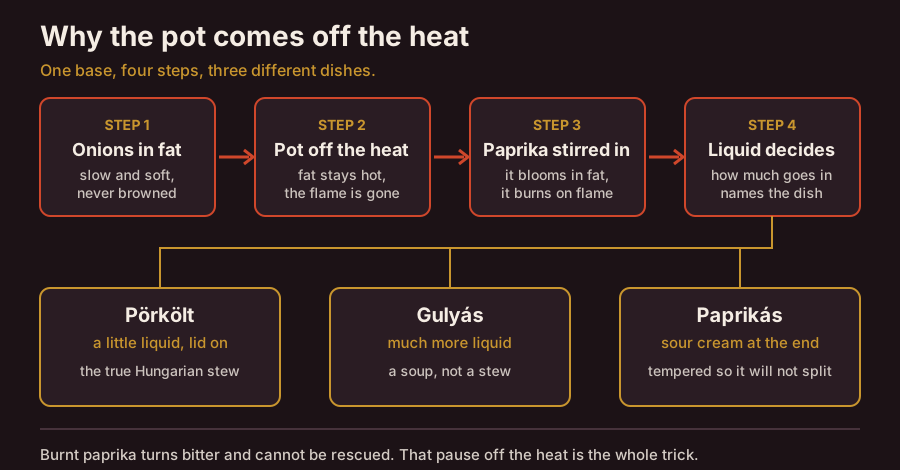
Four steps, in a fixed order. Chopped onion softens slowly in fat until translucent, the pot comes off the flame, ground paprika goes into the hot fat away from direct heat, and only then does liquid or meat arrive. Paprika scorches at frying temperature and turns permanently bitter, which is why the pause off the heat is the whole technique.
Watch a Hungarian cook and you will notice how much time goes into the onion alone. It is not softened for two minutes, it is cooked down until it has almost lost its shape, because in the classic stews there is no roux and no cornflour: the onion melts into the sauce and does most of the thickening. Skimp on that stage and the finished dish tastes thin no matter how good the paprika was.
The off-heat moment is the part visitors misread as fussiness. Ground paprika is full of sugars, and sugars burn. In hot fat off the flame it releases color and a sweet, slightly toasty aroma; over a live burner it goes bitter in seconds and no amount of salt, cream or simmering brings it back. There is no rescue step. That is why my mother moved the pot before she moved the paprika tin, every single time.
| Step | What happens in the pot | Where it goes wrong |
|---|---|---|
| 1. Onion in fat | Chopped onion softens slowly in lard or oil until translucent, never browned | Rushing it, leaving crunch and a thin sauce with nothing to thicken it |
| 2. Pot off the heat | The fat stays hot but the flame is gone | Skipping the pause because the recipe looks like it can be hurried |
| 3. Paprika stirred in | The powder blooms in fat, giving color and aroma to everything that follows | Adding it over the burner, which turns the whole batch bitter |
| 4. Liquid or meat added | The base becomes a specific dish depending on how much liquid goes in | Adding cold sour cream straight to a boiling pot, which splits it |
The final fork in the road is liquid. A little, with the lid on, gives pörkölt, the dense stew most of the world wrongly calls goulash. A lot more gives gulyás, which is a soup with vegetables in it. Sour cream stirred in at the end, tempered first with a spoonful of the hot liquid so it will not curdle, gives you the paprikás family. Same four steps, three different dinners. My goulash crawl notes show what that difference tastes like across a handful of Budapest kitchens.
What Does A Hungarian Home Kitchen Always Keep In The Cupboard?
Ground sweet paprika, a jar of hot paprika paste, fat for cooking, more onions than seems reasonable, sour cream in the fridge, jars of sour pickles, caraway, flour and eggs for dumplings, and fresh bread bought that day. With those nine things a Hungarian kitchen can produce most of the savory canon without a shopping trip.
I cook at home the way I was taught, and I have shopped for these staples in this city since long before I started guiding visitors in 2022. The list below is a home cook's inventory, not a chef's. What surprises people is how short it is. Hungarian cooking gets its depth from technique and time rather than from a long spice rack, so the cupboard stays small and the same six or seven ingredients keep reappearing in different arrangements.
| Staple | What it does | How to buy and keep it |
|---|---|---|
| Ground sweet paprika (édesnemes) | The color, aroma and identity of nearly every savory dish | Buy tins rather than clear jars, keep it dark and cool, replace it yearly as it fades |
| Hot paprika paste | Heat, added at the table by each eater | A tube lives in the fridge door in most households |
| Lard or bacon fat | The traditional frying medium and the carrier for paprika | Oil works, but the flavor of the classics leans on animal fat |
| Onions | The base and the thickener, used by the kilo | Bought in nets, stored dry and dark, never in the fridge |
| Sour cream (tejföl) | The finish for the paprikás family and the topping for főzelék | Full fat splits less; temper it before it meets a hot pot |
| Savanyúság in jars | The sour counterweight beside rich mains | Home-pickled in autumn, or bought by weight from market barrels |
| Caraway and bay | Quiet background notes in soups and stews | Whole seeds, ground or crushed as needed |
| Flour and eggs | Nokedli dumplings, dough, thickening when a recipe calls for it | Standard plain flour is all the classics require |
| Fresh white bread | On the table at every meal, and the tool for finishing a sauce | Bought daily, which is why bakeries are on every second corner |
Two things you will not find in that cupboard: a chili shelf and a stock cube habit. Heat is a condiment here rather than a base note, and soup starts with actual meat and vegetables because it is the first course of most proper meals. If you want the shopping version of this list, tins, grades and what the origin names mean, that lives in my paprika shopping notes.
What Do The Seasons Do To Hungarian Cooking?
A lot, because this is preserving country. Spring returns fresh vegetables to the főzelék pot, summer brings cold fruit soups, freshwater fish and stuffed vegetables, autumn is the paprika harvest and game season, and winter runs on what was pickled and dried earlier: sour cabbage, jarred vegetables, dry sausage and long-simmered stews.
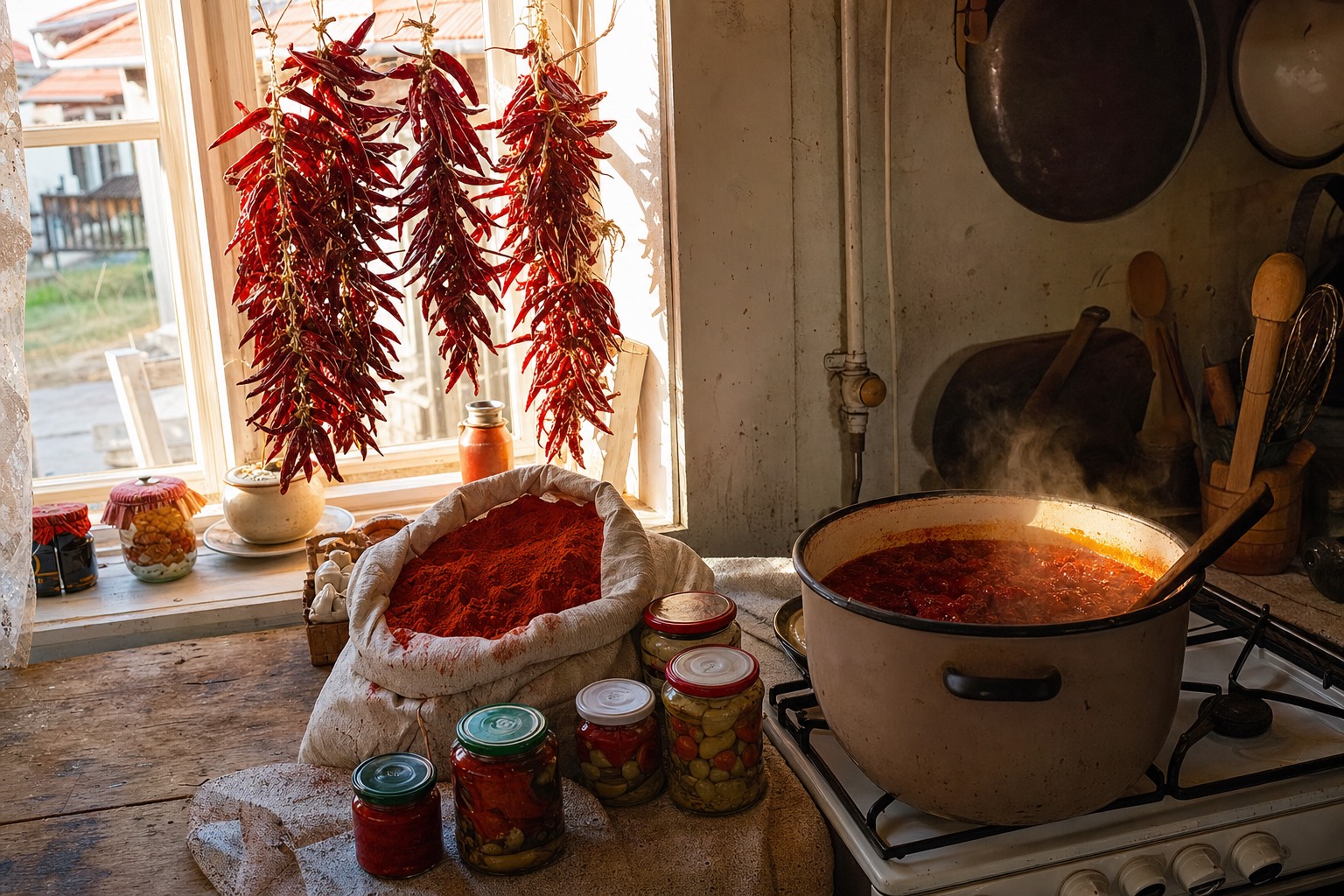
Autumn is the pivot. The paprika crop comes in, gets dried and ground, and the garlands hanging in windows across the southern towns are not decoration, they are inventory. The same weeks fill the jars with cucumbers, peppers and cabbage. A Hungarian household in October is essentially preparing for a winter in which the vegetable aisle used to be a rumour, and the habit survived the arrival of supermarkets because the results taste better.
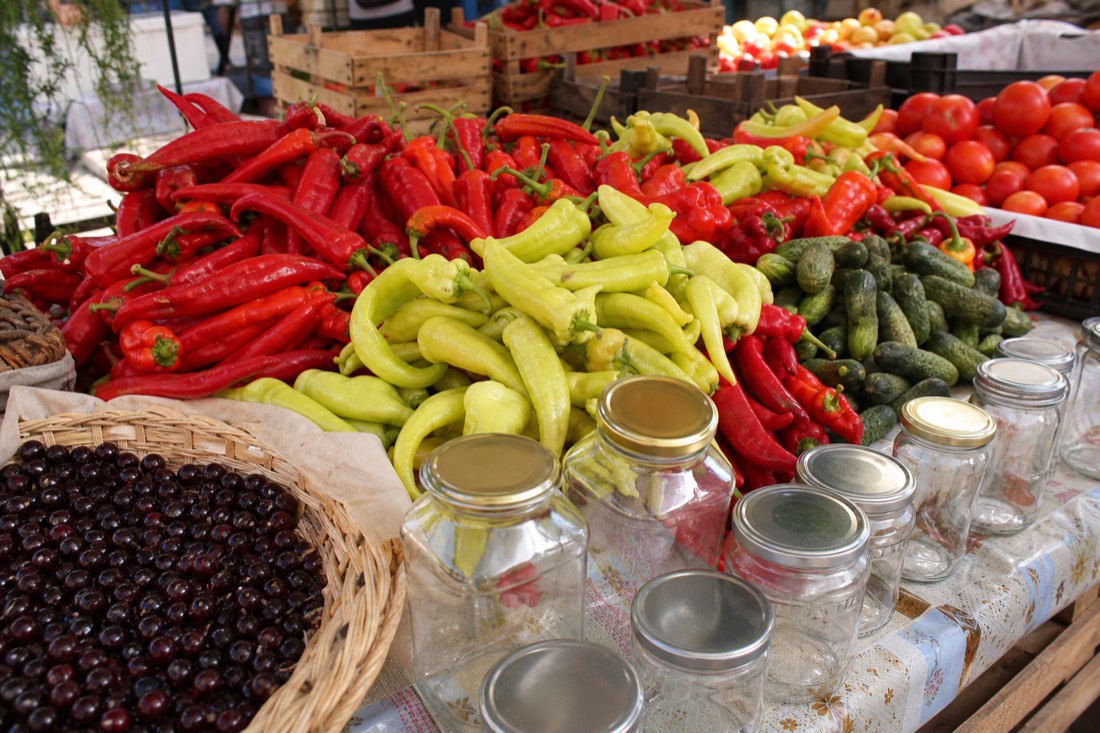
Summer flips the register completely. Cold sour cherry soup, which sounds strange until the first hot afternoon, is served as a first course. Lake Balaton means fried hekk and pikeperch, and beach lángos becomes a food group. Peppers and tomatoes are at their best, so vegetables get stuffed rather than stewed. The heavy paprika canon does not disappear, it just stops being the default choice.
Winter is where the reputation comes from. Stews simmer longer, sauerkraut and stuffed cabbage take over, the dry sausages hung in autumn come down, and the cakes get richer. Spring is the shortest chapter and the lightest: the first green peas and young vegetables go straight into főzelék, and the soup at the front of the meal turns clear again. If you are visiting rather than cooking, the seasonal effect on restaurant menus is real but muted in the capital, where the what to eat in Budapest guide tracks what actually shows up on the plate month to month.
How Does Hungarian Cooking Differ From Its Neighbours?
It shares the pork, dumplings, cabbage and pickles of Central Europe, and the pastry culture of Austria. What none of the neighbours have is the paprika base built as a technique, sour cream used as a finishing acid rather than a richness, and főzelék, an entire tradition of thick vegetable dishes eaten as a main course rather than a side.
Start with the shared vocabulary, because pretending Hungarian food evolved alone would be silly. Pork sits at the center across the region. Dumplings appear in every kitchen from Bohemia eastward, though Hungary's nokedli are small, irregular and pinched into the water rather than shaped into bread-like rounds. Cabbage, fresh and soured, is common ground. Strudel and layered cake culture links Budapest and Vienna directly, and the northwest of Hungary, closest to Austria, cooks in a visibly lighter, more dairy-driven register than the Great Plain does.
The divergence is the red powder, and it is a divergence of method rather than seasoning. Elsewhere in Central Europe paprika is a spice you might add. Here it is the first thing in the pot after the onion, and the dish is built on top of it, which is why Hungarian stews look and taste unlike their Czech or Austrian cousins even when the meat is identical. The south, toward the Balkans, shares the love of peppers, but cooks them mostly fresh and grilled, while Hungary turned the same fruit into a graded dried-spice system with sweet, delicate, hot and smoked classes.
| Neighbouring kitchen | What Hungary shares with it | Where Hungary goes its own way |
|---|---|---|
| Austrian | Strudel and layered cake culture, breaded meats, dairy-rich cooking in the northwest | Paprika as the base of the savory canon rather than a finishing spice |
| Czech and Bohemian | Pork at the center, dumplings on the plate, cabbage in every form | Nokedli pinched into water instead of sliced bread dumplings, and soup before every proper meal |
| Balkan and southern | A love of peppers, grilled meat, sour dairy on the table | Peppers dried and graded into a spice system, sweet to hot, rather than mostly eaten fresh |
| The region generally | Sour pickles as a standing side, preserving as a seasonal habit | Főzelék, a whole tradition of thick vegetable dishes eaten as the main course |
Then there is the sour cream, which is the quiet signature. It goes in at the end, cold, tempered, and it sharpens the dish rather than enriching it the way cream does further west. Add the soup-first custom, the standing plate of pickles, and the főzelék tradition that gives the cuisine a genuine vegetable spine, and you have four structural differences rather than a menu of similar dishes with a different accent. The Vienna comparison is the one visitors run most often, and I unpack it plate by plate in Vienna versus Budapest eating.
What is the national dish of Hungary?
Gulyás, the paprika beef soup, holds the title by consensus. At home the Sunday húsleves and paprikás csirke are just as central to how Hungarians actually eat.Is Hungarian food spicy?
Not by default. The base grades of paprika are sweet and aromatic. Heat comes from optional hot paprika paste and pickled peppers added at the table, so each eater sets their own level.What do Hungarians eat for breakfast?
Usually simple: fresh bread or rolls with butter, cold cuts, cheese, peppers and tomatoes. The big cooked meal of the day is traditionally lunch, not breakfast.Is Hungarian cuisine similar to other Central European food?
It shares the pork, dumpling and pickle vocabulary of its neighbors, but paprika, sour cream and the főzelék vegetable-main tradition give it a flavor identity none of the surrounding cuisines have.Choose Your Budapest Experience
Hungarian Cooking In A Local Home. Prepare a Hungarian main course and dessert with a local chef; ingredients, equipment and a recipe booklet are included. Have a date in mind? Check it before arranging the rest of your Budapest day.
240 minutes. Select the morning market option for the market visit; the evening option starts at the apartment. The operator cannot accommodate coeliac disease.
Choose a date to see scheduled departures. Final availability and price are confirmed on Viator.
No verified experience fits those requirements. Adjust your choices, or keep the independent plan described above.
Compare Options And Fit Your Plans
General recommendations until you choose. Sightseeing cruises use recorded commentary; the dinner cruise has no guide. All selected activities meet in central Pest; use the operator confirmation for the exact point and option.
- Foodapest Market To Tavern: 180 minutes. Traditional dishes, street-food tasters and wines with an English-speaking local guide. Daytime option visits the market; the 17:00 option skips it. Notify the operator about vegetarian or vegan substitutions. Not suitable for coeliac requirements.
- Goulash Cooking At Chefparade: 180 minutes. Make goulash soup, a paprika main and apple strudel in a hands-on three-course cooking class. Age 6+. Studio address is confirmed as Páva utca 13 or Bécsi út 27. Vegetarian menu on request; confirm the menu and dietary requirements before booking.
- Carpe Diem District VII Food Walk: 150 minutes. Four Hungarian eateries, three drinks and an English-speaking guide through District VII. 150 minutes; meet outside the Orthodox Synagogue on Kazinczy utca. Vegetarian and alcohol-free options; no vegan or gluten-free diets.