Vienna vs Budapest for Food: A Local's Honest Verdict
Which is better for food, Vienna or Budapest? A Budapest local compares Michelin counts, restaurant prices, café culture and wine, with real 2026 numbers.
 By Gábor Kovács, Budapest local specialist and experience guide
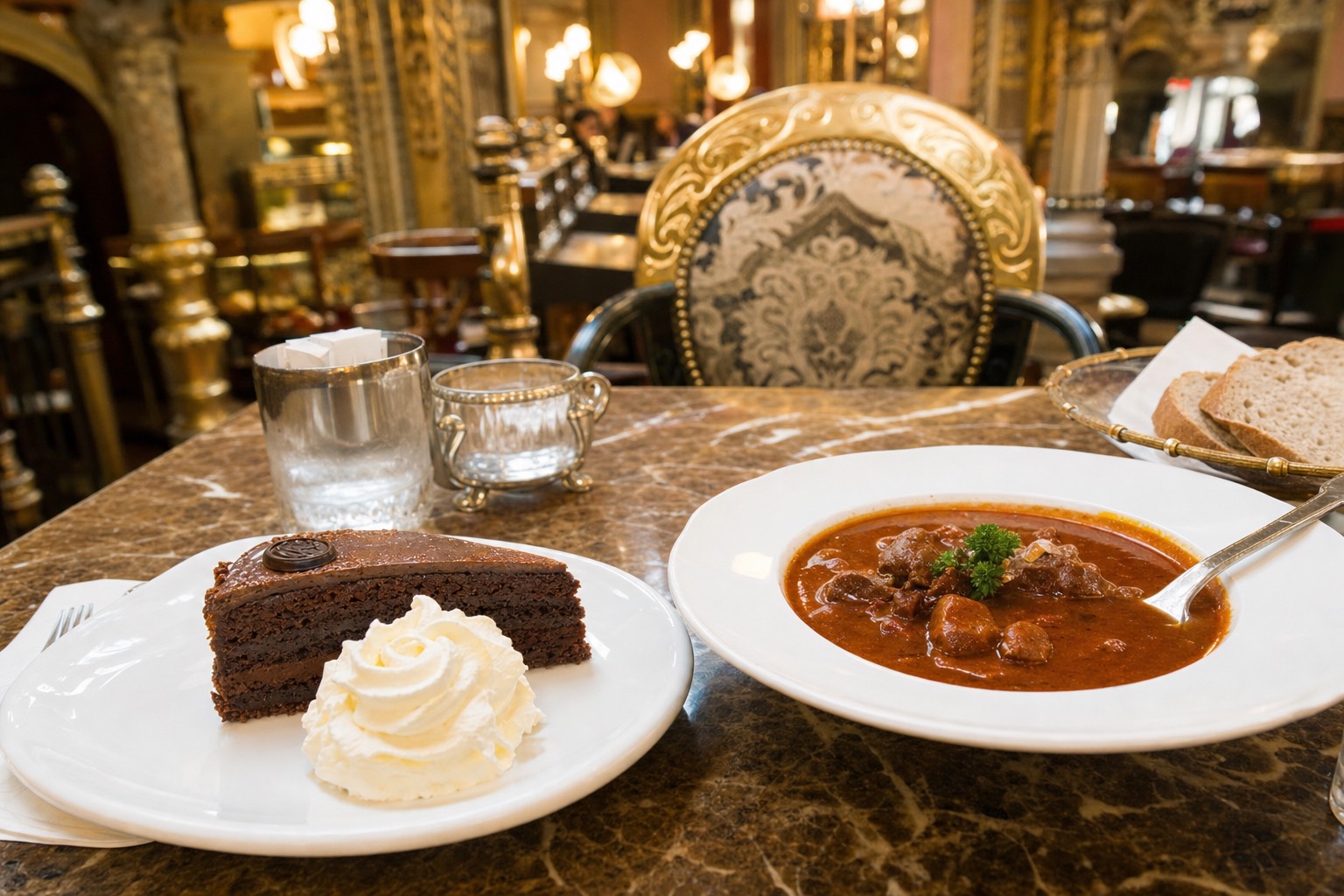
Vienna is my neighbor. From Budapest it is a morning train away, close enough that I go for weekends, far enough that the food changes completely at the border. People ask me which city eats better as if I might be diplomatic about it. I am not going to be diplomatic. I am going to be specific, because the honest answer depends on what you are hungry for, and the numbers cut both ways.
If Budapest wins your comparison, give its food more than one restaurant stop. Foodapest’s three-hour route combines traditional dishes, street food and drinks with a local guide.
Booking choice: Foodapest combines traditional dishes, street-food tasters and wines in a three-hour guided walk. Explore Foodapest Market To Tavern
Which City Is Better For Food, Vienna Or Budapest?
Vienna wins on polish: more stars, grander pastry, deeper wine lists. Budapest wins on flavor per euro, market culture and the sheer fun of eating. Restaurant prices in Vienna run about 42 percent higher for comparable meals, so the real question is whether refinement or character is worth more to you.
That is the verdict up front, and I will spend the rest of this piece earning it. I grew up on my mother's paprikás and I still order Tafelspitz, boiled beef in broth, every time I am in Vienna. Both cities feed you well. They just feed you differently, and the differences are measurable.
Which City Has More Michelin Stars?
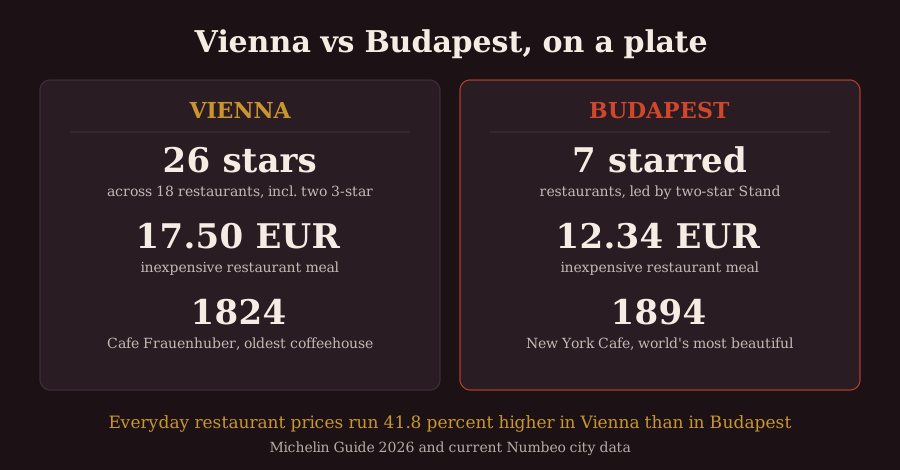
Vienna, decisively. The 2026 Michelin Guide gives Vienna 26 stars across 18 restaurants, including two three-star rooms. Budapest entered 2026 with seven starred restaurants, topped by the two-star Stand. If your trip is built around fine dining, Vienna has the deeper bench.
The Austrian side of the ledger is documented in the Michelin Guide Austria 2026 announcement: Amador and Steirereck im Stadtpark hold three stars each, with four two-star rooms behind them. Budapest's current roster, tracked by Offbeat Budapest, runs seven starred kitchens.
| Vienna | Budapest | |
|---|---|---|
| Total Michelin stars | 26 across 18 restaurants | 8 across 7 restaurants |
| Three-star restaurants | 2 (Amador, Steirereck im Stadtpark) | 0 |
| Two-star restaurants | 4 | 1 (Stand) |
| One-star names | Includes Konstantin Filippou, Mraz & Sohn | Babel, Borkonyha, Costes, essência, Rumour, Salt |
I will say this for my city, though: Budapest's starred rooms are young and hungry, and Borkonyha will pour you serious Hungarian wine with a confidence Vienna reserves for its own bottles.
Where Do You Eat Cheaper?
Budapest, by a wide margin. An inexpensive restaurant meal costs the equivalent of 6,373 forints, about 17.50 euros, in Vienna versus 4,495 forints, about 12.34 euros, in Budapest. That makes Vienna's restaurant prices roughly 41.8 percent higher for the everyday eating that fills most of a trip.
The gap comes straight from Numbeo's current city comparison, and it compounds meal after meal. Fine dining converges at the top; the everyday tier does not.
| Everyday meal | Vienna | Budapest |
|---|---|---|
| Inexpensive restaurant meal | 6,372.94 Ft equivalent (17.50 EUR) | 4,495 Ft (12.34 EUR) |
| The premium you pay in Vienna | +41.8 percent | baseline |
What the table cannot show is what the cheaper meal is. In Vienna the budget tier means sausage stands and lunch canteens, decent but functional. In Budapest it means a cooked two-course lunch menu, a market hall counter, a bowl of real goulash. My rundown of what to actually order here is, in effect, a list of things that cost less than a Viennese appetizer.
Whose Coffeehouse Culture Is Greater?
Vienna's is older and institutionally deeper: its coffeehouse culture has been listed on Austria's national inventory of intangible cultural heritage since 2011, and Café Frauenhuber has poured continuously since 1824. Budapest's answer is fewer rooms but higher drama, led by the New York Café, open since 1894.
I have to concede the history. Vienna's coffeehouse tradition carries UNESCO-linked heritage status, and sitting in Frauenhuber you feel the two centuries in the upholstery. Nobody hurries you. The newspaper racks are real. It is coffee as citizenship.
Budapest plays a different card: spectacle. The New York Café, opened in 1894 inside the New York Palace, was first crowned the most beautiful café in the world in 2011, the same year Vienna's tradition got its heritage listing, which I find poetic. Gilded balconies, frescoed ceilings, a queue out the door. Our café story, and the golden age that built those rooms, is one I tell at length in my piece on Budapest's grand café culture.
| Café tradition | Vienna | Budapest |
|---|---|---|
| Signature room | Café Frauenhuber, serving since 1824 | New York Café, opened 1894 |
| Claim to fame | Heritage-listed coffeehouse culture (since 2011) | "Most beautiful café in the world" (first named 2011) |
| The experience | Unhurried, literary, newspapers on racks | Operatic, gilded, worth the queue once |
How Do The Classic Dishes Compare?
Vienna's classics are refined restraint: Wiener schnitzel, Tafelspitz, Sachertorte. Budapest's are seasoned conviction: goulash, chicken paprikás, lángos, chimney cake. Vienna perfects a small canon; Hungarian cooking argues with you, in the best way, through paprika, sour cream and fire.
This is where I stop pretending to be neutral. Viennese food is technically superb and emotionally reserved. A perfect schnitzel is a perfect schnitzel, and then it is over. Hungarian food takes risks. Our paprika is not decoration, it is an argument; our lángos (fried dough rubbed with garlic, loaded with sour cream and cheese) is indefensible and correct.
Pastry is the closest fight. Sachertorte against our Dobos torta, caramel-topped and layered, is a coin flip I refuse to call sober. Strudel belongs to both empires and neither will admit it.
Street level settles it for me, though. Vienna's Würstelstand sausage stands are a beloved institution, but they are one institution. Budapest answers with a market hall the size of a train station, chimney cake kiosks, and lángos windows that have queues at midnight. On the sidewalk, my city simply has more to say.
Which City Drinks Better?
For beer and formal wine service, Vienna. For wine discovery, Budapest, and it is not close. Hungary's volcanic whites, Tokaji sweets and Eger reds are barely exported, so tasting them here is tasting something you genuinely cannot get at home. Vienna's cellars are deep but hold few surprises.
Austrian Grüner Veltliner is wonderful and available in every wine bar from London to Tokyo. Hungarian wine mostly is not, which makes Budapest the more interesting glass. The bottles I grew up around, dry Furmint, Kékfrankos, old-vine Hárslevelű, still surprise sommeliers who visit, and the wine tastings we compare exist precisely because the labels mean nothing to newcomers without a guide.
So Which City Should You Actually Pick?
Pick Vienna for a fine-dining pilgrimage or imperial pastry. Pick Budapest for everything else: markets, wine, street food and value. Best of all, refuse to choose; the cities sit a short train ride apart, and eating them back to back is the finest food argument in Central Europe.
My honest routing advice, as someone with a foot on each platform: do both, but sleep more nights in Budapest. Your budget stretches 40 percent further here, the wine is stranger, and breakfast at a market hall beats breakfast anywhere in the First District. Then take the train west and let Vienna win the pastry course. Everybody goes home fed and nobody has to be wrong.
Choose Your Budapest Experience
Foodapest Market To Tavern. Traditional dishes, street-food tasters and wines with an English-speaking local guide. Have a date in mind? Check it before arranging the rest of your Budapest day.
180 minutes. Daytime option visits the market; the 17:00 option skips it. Notify the operator about vegetarian or vegan substitutions. Not suitable for coeliac requirements.
Choose a date to see scheduled departures. Final availability and price are confirmed on Viator.
No verified experience fits those requirements. Adjust your choices, or keep the independent plan described above.
Compare Options And Fit Your Plans
General recommendations until you choose. Sightseeing cruises use recorded commentary; the dinner cruise has no guide. All selected activities meet in central Pest; use the operator confirmation for the exact point and option.
- Budapest Culinary And Wine Walk: 300 minutes. Explore food markets and neighbourhoods with an English-speaking food specialist, tasting Hungarian dishes and wines along the way. Allow five hours and substantial walking. Current option is private; private transport and gratuities are excluded. Dietary arrangements require confirmation.
- Private Café History Walk: 180 minutes. Explore grand coffeehouses with an art historian, including New York Café in the documented route. Meet outside Gerbeaud at Vörösmarty tér 7–8. Refreshments and tips cost extra. This is a guided café-history walk, not a New York Café table reservation or queue-skip ticket.
- Goulash Cooking At Chefparade: 180 minutes. Make goulash soup, a paprika main and apple strudel in a hands-on three-course cooking class. Age 6+. Studio address is confirmed as Páva utca 13 or Bécsi út 27. Vegetarian menu on request; confirm the menu and dietary requirements before booking.
- Hungarian Wine And Cheese Tasting: 90 minutes. Explore five Hungarian wines with a sommelier, artisan cheeses and charcuterie at a communal table. Ages 18 and over. Vegetarian alternatives require advance notice. The cellar is not wheelchair accessible; extra food and drinks cost separately.